
A Young Settler Sacrificed for the Land
Israel’s child soldiers in the West Bank; ferocious pogroms after a young settler’s death; Democratic politicians issue ritual condemnations.
Infinite Jaz exists because I believe reporting on Israel-Palestine, and the systems of power that shape it, should not be filtered through the priorities of billionaires and politically biased, risk-averse institutions.
But all of my reporting is self-funded, and it cannot continue without your support. If you believe in the importance of independent journalism, please consider becoming a paid subscriber—you’ll gain access to the full archive of subscriber-only reporting and help cover my upcoming reporting trips to the West Bank.
Last Saturday afternoon in the northern occupied West Bank, three young settlers from Shuva Yisrael Farms—an illegal hilltop outpost outside of Nablus—set out on their ATV for a “land patrol” of Palestinian villages in PA-controlled Area A. It ended in a collision with a truck driven by a Palestinian that left one of them, 18-year-old Yehuda Sherman, dead. What followed was a series of settler pogroms that, even by today’s standards, were shocking in their ferocity and scale.
There are two different versions of what led to Yehuda Sherman’s death. In one, it was a traffic accident on a dangerous road. In the other, it was a terrorist car-ramming attack by a Palestinian driver.
At first, Israeli police said they were investigating it as an accident. The Palestinian driver, who turned himself in after being released from the hospital, maintained that it was just that. As have local witnesses.
But almost immediately, Yehuda’s older brother Daniel—the leader of the outpost who was with him on the ATV—was telling reporters from his hospital bed that the truck had deliberately accelerated into them, sending the ATV careening into a ravine, after which they were surrounded by local “Arabs” who threw stones and cursed at them for forty minutes before Israeli security forces rescued them.
The terrorist car-ramming claim was quickly amplified by settler leaders, politicians, and right-wing media, who wasted no time in calling for revenge:
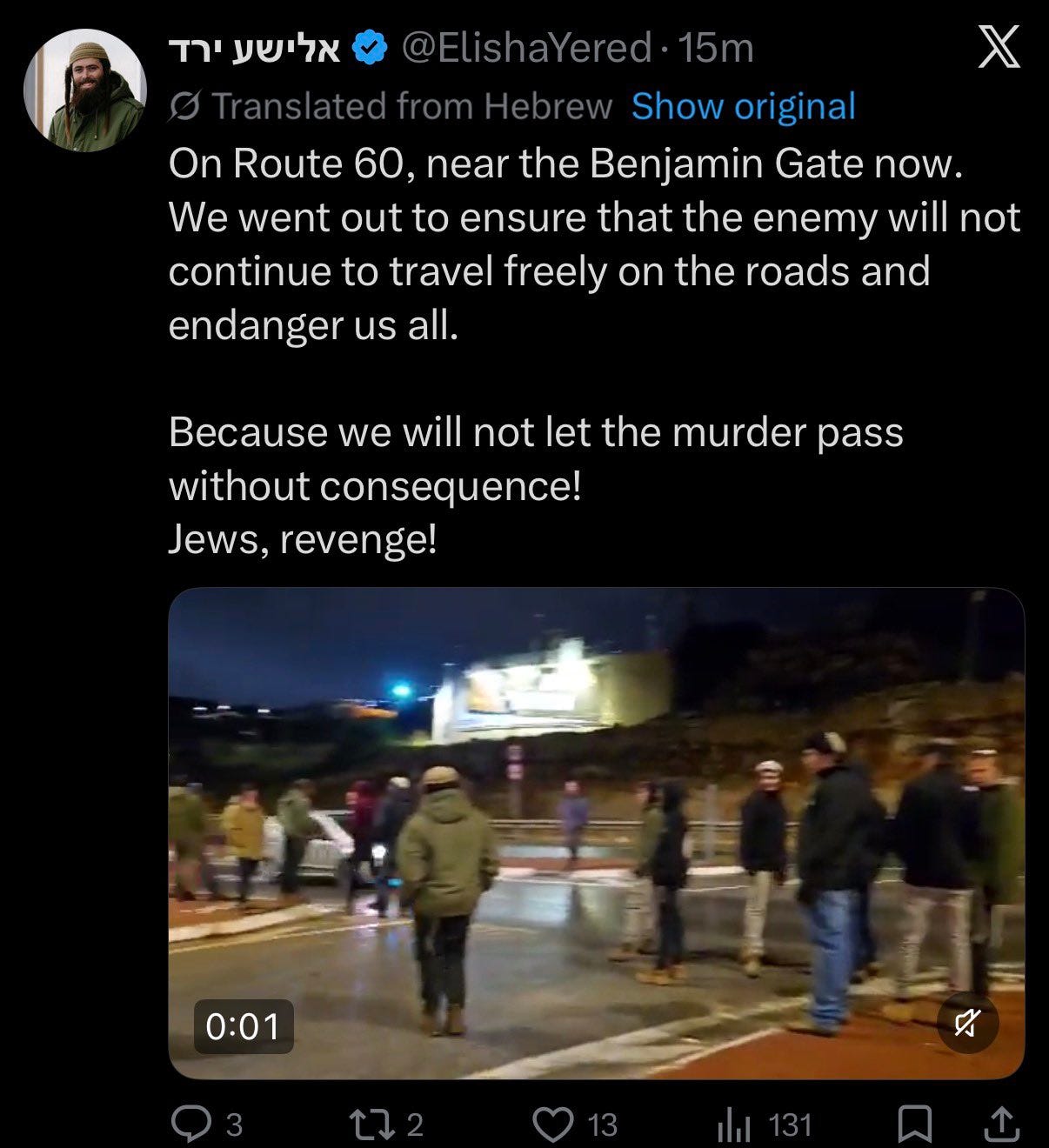
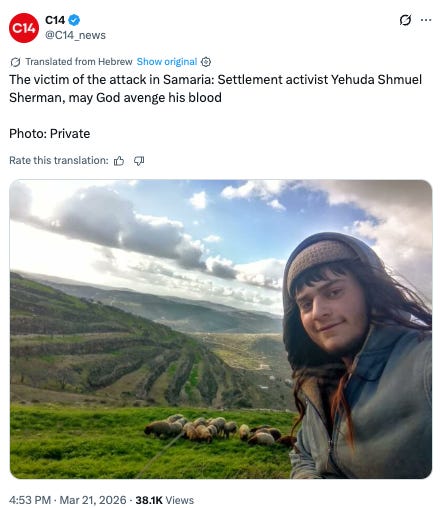
Within hours of Sherman’s death, hundreds of settlers were descending on small villages across the northern West Bank in coordinated raids—moving in successive waves between communities, throwing stones and Molotov cocktails, setting homes and cars ablaze, and beating residents. Israeli troops and police were present in multiple locations but did nothing to stop the attacks. Dozens of Palestinians were injured, and residents described widespread terror as violence spread to roughly twenty locations in a single night.
On Sunday, new footage emerged from the aftermath of the wreck, showing Palestinian residents and Red Crescent workers evacuating and treating the wounded settlers, directly contradicting Daniel Sherman’s account, and calling into question his characterization of the collision itself.
But the die had already been cast.
That same day, Yehuda Sherman’s funeral was held. His father described him as a sacrifice offered up by the Jewish people in the struggle to establish Jewish settlements across the West Bank and prevent the creation of a Palestinian state. In a later interview, he recalled 11-year-old Yehuda “walking on Sabbaths to remote hills to reinforce them.” He called on the government to abolish the Oslo Accords and vowed to establish three new illegal outposts in his son’s name.
Finance Minister and de facto West Bank Governor Bezalel Smotrich spoke too, promising that, in Yehuda’s memory, they would “erase the lines, the definitions and the letters, and settle our land in all its parts”—the lines and letters a reference to Oslo’s Areas A, B, and C—and “collapse the authority of evil and terror called the Palestinian Authority.”
Together, the speeches served as a rallying cry for vigilante support for policies the Israeli government has been implementing for years.
As the funeral was underway, messages circulated in settler WhatsApp groups urging supporters to once again gather at junctions across the northern West Bank to seek “revenge and the expulsion of the enemy.”
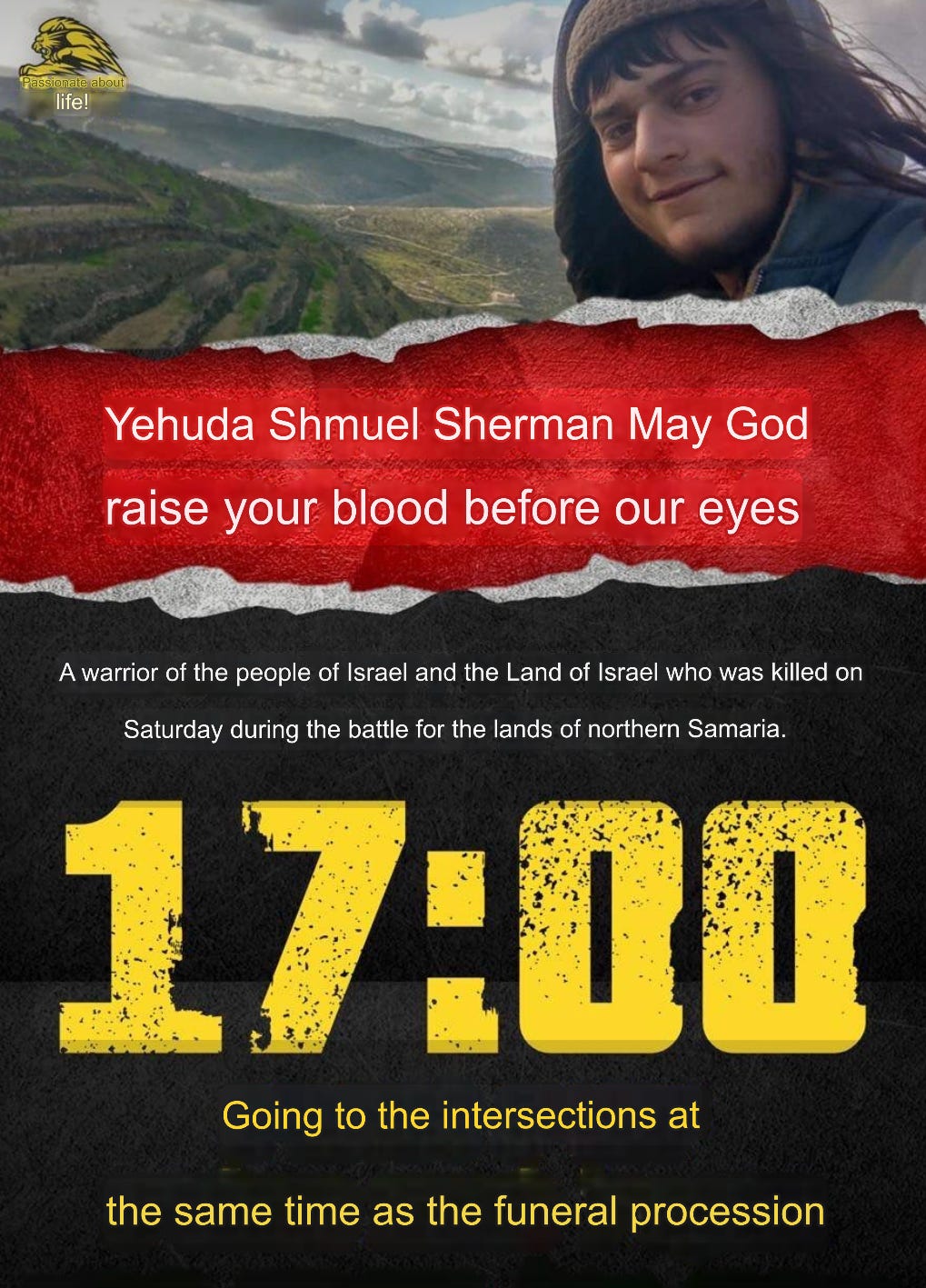
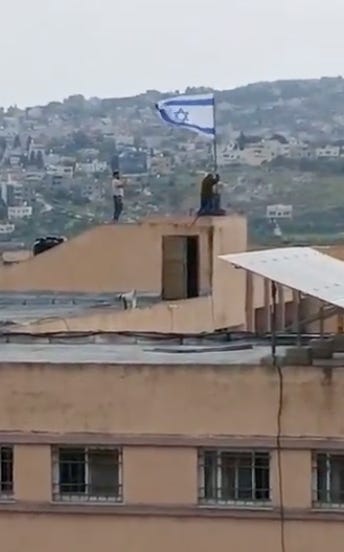
The spate of pogroms entered its second night. In the village of Deir al-Khatib near Nablus, settlers set fire to buildings and vehicles, threw stones at homes, and shot at residents, wounding at least ten Palestinians, including one man hit in the leg. In Deir Sharaf, several cars were torched. Near Qaryut, tires were burned and Israeli flags were raised. In the Jordan Valley, settlers beat an activist badly enough to require emergency medical treatment. In the nearby village of Burqa, settlers torched a vehicle and a local tourist agency and attempted to set fire to a clinic. In Hawara, settlers broke into a Palestinian high school, removed the rooftop Palestinian flag and raised an Israeli one in its place, spray-painting revenge slogans, including “A good Arab is a dead Arab.”
On Thursday, as the pogroms entered their sixth day—or, perhaps, as a new baseline of violence took hold in the West Bank, who’s to say?—the Shin Bet announced that the Palestinian driver had “admitted to the acts attributed to him,” though they did not specify what acts. His interrogation took place without the presence of a lawyer, a setting in which purported confessions by Palestinians should hardly be taken at face value. The Shin Bet also reported that “suspicion is growing” that the crash was deliberate, an unusually ambiguous framing in the context of a supposed confession.
Despite these reasons for doubt, plus my own hard-earned distrust of Israeli authorities, it is not implausible to me that this was, in fact, a deliberate car-ramming. During the Second Intifada, attacks on settlers were fairly common, and having dealt with many settlers myself, I understand just a fraction of the restraint required of Palestinians in the West Bank, and am often surprised it does not break more often. So, even though I’ve seen no evidence to support it, I’ll assume for the sake of argument that this is what happened.
In that case, the extremist leaders of the settlement movement got exactly what they were looking for. For decades, its most ideological wing has been explicit about its goal: a decisive, even messianic confrontation to settle the land dispute once and for all. A holy war, if you will.
On a crowdfunding page for Shuva Yisrael Farms, the illegal outpost where Yehuda lived, its mission is described as being “the spearhead for activities throughout northern Samaria with the goal of seizing the lands and leaving them in Jewish hands.” At the funeral, a fellow hilltop settler described Yehuda’s work as part of a “strategic mission” to expel Palestinians from the West Bank and advance Jewish settlement in the territory. The settler leader Elisha Yered, whose call for “Jews, revenge!” preceded the pogroms, said earlier this month on a podcast, referring to incursions into Palestinian villages, “Without question, we are initiating friction. And we’re proud of that.”
Anyone who has spent time in Palestinian villages in the West Bank is familiar with the type of “land patrol” that Yehuda was conducting before his death. The settlers often arrive on state-gifted ATVs, circling village perimeters, chasing shepherds off their own farmland, sometimes brandishing weapons. At times they dismount, entering the villages themselves, even homes, getting in the faces of residents and activists, playing a high-stakes version of the child’s game I’m not touching you. In some cases, they are children, as young as ten or eleven. Some, like Yehuda, are born into long-established settler families—his grandfather made aliya from Cleveland in 1973. Others are at-risk youth from within Israel, adopted by outpost communities, some of which are formally recognized as foster institutions, and conscripted as child soldiers in a war against their neighbors. In either case, when they show up in Palestinian communities, they are fishing for an opportunity to escalate—to (literally) call in the big guns.
Here’s a clip I filmed in October of a “land patrol” in a tiny Bedouin community east of Duma:
After this video, the same young settler returned three more times to take pictures before sending a drone to hover just above us.
As I wrote last week,
In the months since my visit, the harassment intensified: electricity lines cut, homes vandalized and filled with pepper spray, and residents repeatedly forced to flee. Eventually, the IDF declared the village a “Closed Military Zone,” barring activists from entering—a familiar tactic that creates the appearance of restoring order while leaving Palestinians more exposed to settler violence. The assaults intensified immediately, and the remaining residents understood that if they stayed, they might be killed.
Soon, the village was abandoned.
In other words, “land patrols”—like the raison d’être of Yehuda’s outpost and the broader hilltop movement—are not meant to maintain stability, but to intimidate Palestinians into leaving, or provoke a response that can then be used to justify overwhelming force and, ultimately, expulsion.
And so, Yehuda’s corpse immediately became grist for the mill—a “sacrifice,” as his own father called him—as settlers fanned out and established five new outposts in a matter of days, exceeding his father’s goal of three. Three of them were in PA-controlled Area A, effectively heeding Smotrich’s call to erase Oslo’s lines.
This is a tradition in the West Bank, settler funerals doubling as political rallies meant to channel grief into territorial expansion. Leaders like Smotrich attend to announce retaliatory “new” settlement drives that, in reality, have been planned for months or years—a “Zionist response,” as they call it. Sitting shiva is accompanied by organized violence.
On Thursday, as settlers were reconstructing a previously evacuated outpost, they opened fire on a group of Palestinians who confronted them, killing one and wounding several others—direct casualties of the incitement from Smotrich, Yehuda’s father, and countless others.

As videos of settler violence swept across social media last week, pro-Israel Democratic politicians, some backed by AIPAC, lined up to condemn it, frame the violent settlers as a radical fringe, and call for the Israeli government to prosecute them.
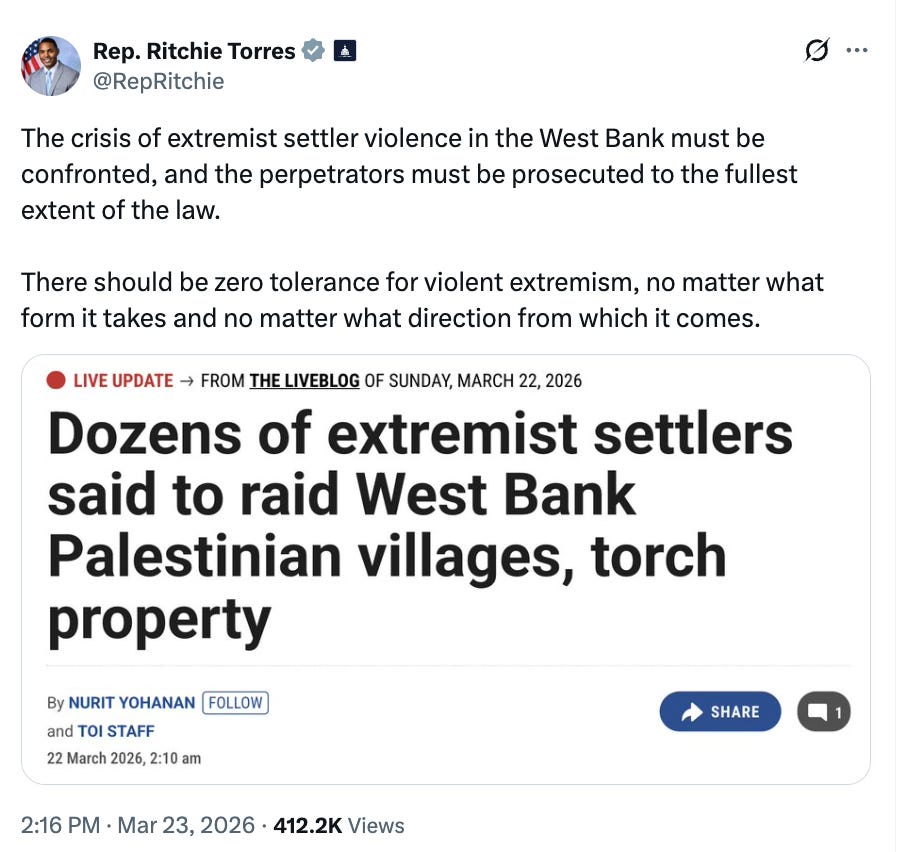
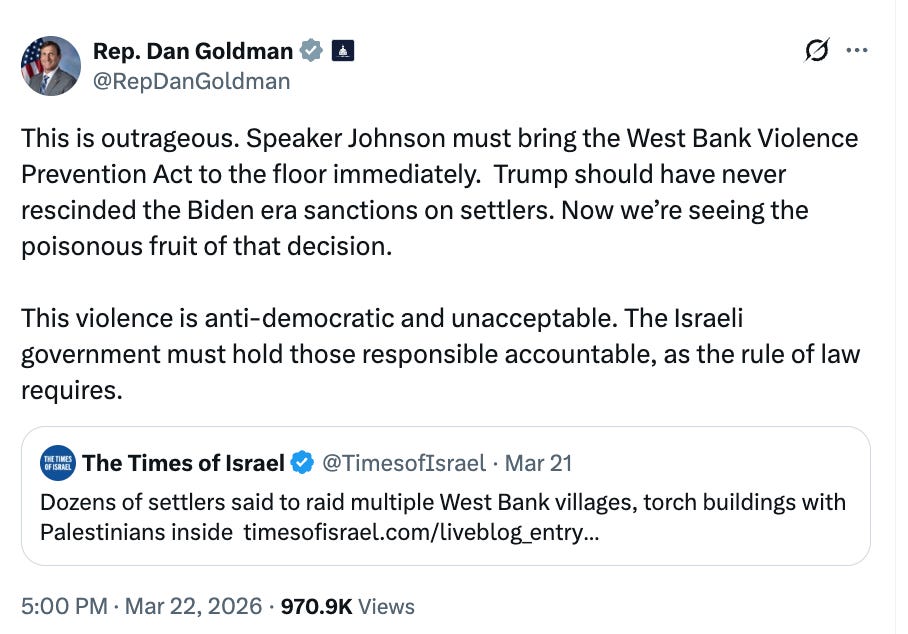
Dan Goldman, my own representative who ignored me when I was attacked by settlers in October, has not used any of his own leverage—namely, conditioning U.S. military aid on compliance with human rights law—to pressure Israel to act, instead pushing for Trump to reinstate sanctions on a handful of settlers.
Even AIPAC itself got in the mix:
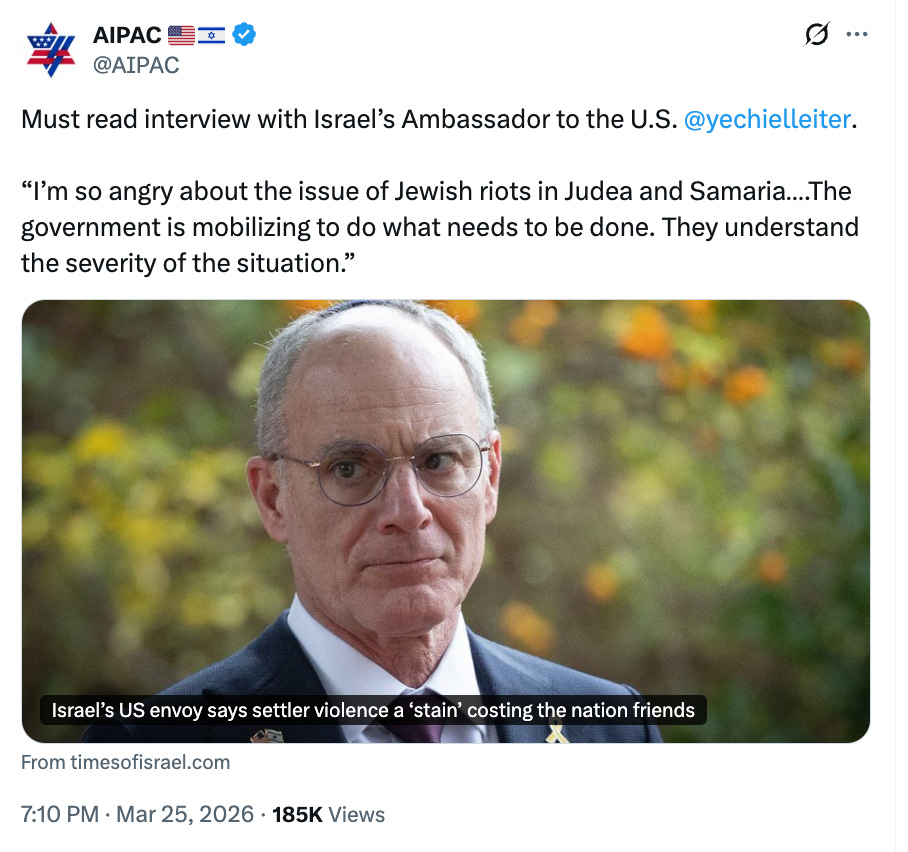
Many people speculated that the condemnations were coordinated, but I’m not convinced. For years, ritual condemnations of settler violence have functioned as a release valve for Israel’s supporters when the pressure becomes untenable. In this case, the videos were undeniably awful, and there was just no way to spin them. Rather than defend the indefensible or pretend they don’t exist when millions had seen the footage, they understood that the better approach was to frame the violent settlers as an unfortunate aberration. Even some settler leaders, who tend to reflexively defend violent settlers as acting in self-defense, sought to distance the perpetrators from the broader movement. I’d put AIPAC in that same category.
But beyond that, settlers have long been a thorn in the side of “liberal Zionists,” who require the possibility of a two-state solution as a political and rhetorical device to justify their support for Israel. It allows them to imagine Israel as a state that is both Jewish and democratic, because Palestinians would be partitioned off into their own state. Without that partition, the remaining possibilities are (1) ethnic cleansing, (2) apartheid, or (3) recognizing West Bank Palestinians as citizens of Israel, chipping away at its Jewish majority. The first two are the present reality, but cannot be openly endorsed by any good liberal; the third would mean relinquishing the idea of a Jewish state. So the illusion of a two-state solution must be maintained.
But the settlers are clear, in both word and deed: there will be no two-state solution; the liberal Zionists can say what they want, but they’ll be creating facts on the ground until “Judea and Samaria” is controlled entirely by Jews.
In that sense, I believe many of these lawmakers do, in fact, dislike the wayward settlers who create political problems for them—but their condemnations are entirely toothless, calling on the Israeli government to crack down as though the problem were simply a lapse in enforcement. To be sure, impunity is part of the story: as the Guardian just reported, no settler or soldier has been indicted for killing a Palestinian in the West Bank since 2019 (!!!). But that framing obscures the more important fact that the Israeli government and military are not bystanders to settler violence, but active participants in and direct beneficiaries of it.
This week, as even Israeli government and military officials condemned the surge in settler violence, the government approved some $16 million in new funding for illegal outposts—money earmarked for the infrastructure that makes territorial expansion possible: ATVs, drones, night-vision gear, cameras, generators, floodlights, and access roads. And on Wednesday, ministers reportedly approved the retroactive legalization of 30 more wildcat outposts across the West Bank, exactly the kind of illegal sites that serve as launching pads for violent attacks—“the spearhead for activities with the goal of seizing the lands and leaving them in Jewish hands,” as Yehuda’s outpost boasts.
As this obscene hypocrisy unfolded, a YNet article quoted a senior Israeli security official blaming Smotrich’s funeral speech for inciting violence before adding, “There is no problem with the growth of settlements, but it requires a different, broader strategic approach.”
This security official surely knows that settler violence is a central component of the “broader strategic approach” to settlement growth, which has been thoroughly documented in the Israeli press:
The army partners with settler leaders to plan and approve new outposts—mapping sites, coordinating with commanders, and issuing orders for how they will be secured.
Settlers then establish the outposts themselves—planting flags and caravans on Palestinian land and cutting access roads.
The state provides them with military protection; some are gifted guns, drones, ATVs, other military-grade gear, money, and infrastructure.
The settlers fan out from their new outposts, terrorizing neighboring villages, often with soldiers either standing alongside them or clearing the way, emptying the land of Palestinians—more than 70 rural communities have been violently expelled since October 7.
When the footage gets bad enough, Israeli leaders issue condemnations and, on rare occasions, arrest a settler foot soldier but never the architects.
Then, quietly, the state incorporates the gains—retroactively legalizing the outposts, paving the roads, and absorbing the stolen land into the ever-expanding settlement project.
This folds into an even broader strategic approach, which is to move beyond the old settlement heartlands in Area C, encircle Palestinian towns in Areas A and B, choke off access to farmland and grazing areas, and sever the roads that connect them. Smotrich laid this out plainly in September when he introduced his “sovereignty plan,” which would place roughly 82% of the West Bank under full Israeli control while confining Palestinians to a handful of dense, isolated population centers. From there, Israel could annex most of the territory under the principle of maximum land, minimum demographic change—sidestepping the thorny question of citizenship that full annexation would entail.
As government and security officials, soldiers, settlers, and every Israeli journalist know, there is simply no way to carry out this scale of settlement expansion without violence. A remarkable new clip from CNN’s Jeremy Diamond, filmed as he reported on a brutal settler attack that left an elderly man with a fractured skull, captures the settler-soldier collaboration at the heart of this process.
In the footage, soldiers assault his cameraman, then openly admit they are seeking revenge for Yehuda Sherman’s death—“If the state doesn’t address what they did … what do you expect us to do?” They go on to say they believe the entire West Bank belongs to the Jews, and that they are proud to help transform illegal outposts into legal settlements: “Of course … I help my people.”1
But settlers had been attacking Tayasir with military backup long before Yehuda Sherman died on a road 25 kilometers away—this is simply the latest pretense for the fundamentally violent process of building a new outpost.
For the settler movement, everything that happens in the West Bank is teleological—engineered or rapidly retrofitted to work toward that same end. Such is the nature of “settling”: pushing past the boundary, provoking a response, and then using that response, whatever it may be, to justify further violence and expansion. If there is no response, all the better—the land is theirs for the taking.
It happens at every level. On Wednesday, settlers erected an impromptu barricade on a Palestinian road near Umm al-Khair. When a convoy of workers veered off-road to bypass it, Israeli settlers and soldiers opened fire, killing one and wounding seven others, later accusing them of being “Arab smugglers” and pushing to make the roadblock permanent.
Last month, a cabinet decision authorized Israeli enforcement bodies to carry out demolitions and halt Palestinian development in Areas A and B under the pretext of protecting archaeology, heritage, water, and the environment. But the occupation routinely degrades basic municipal functions, producing the very neglect it then uses to justify intervention—another self-fulfilling prophecy within the larger biblical prophecy of Greater Israel.
Today, even Israel’s “liberal opposition leader,” Yair Lapid, openly frames Israel’s mandate over the land as biblical. Asked about Ambassador Mike Huckabee’s claim that Israel has a right to the territory between the Nile and the Euphrates, Lapid concurred: “Zionism is based on the Bible. Our mandate over the land of Israel is biblical… the biblical borders of the land of Israel are clear. Therefore, the borders are the borders of the Bible.” He added that “security and policy considerations” prevent Israel from taking it all, but those constraints are clearly not fixed—in the month since, the situation already seems to have changed in Lebanon, with Israel announcing plans to occupy the country from its southern border to the Litani River.
“The train on which the pioneering settlement is riding on the way to the complete Land of Israel can no longer be stopped,” settler leader Elisha Yered wrote Friday on X. “The choice is in the hands of every Jew—whether to join it or to try to throw sticks in its wheels and miss the history.”
The choice is also in the hands of Israel’s “liberal” backers outside its borders—the Dan Goldmans and Richie Torreses of the world. Respectfully, I believe it’s time for them to get with the program.
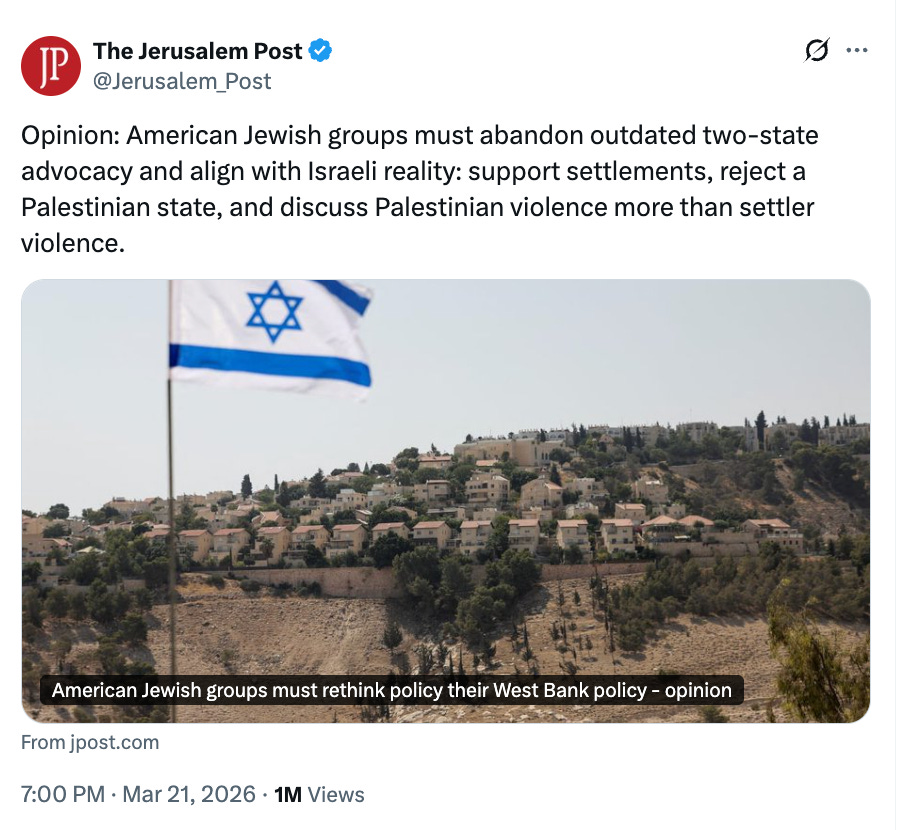
Instead of continuing to support an Israel that doesn’t exist, they can be like the author of this piece, Aliza Pilichowski—a Cali native who moved to the West Bank and became the mayor of a settlement—championing a nation in which “the mere suggestion of a two-state solution – or any solution to end the Israeli-Palestinian conflict – is laughed off as naive and unrealistic.”
They can heed her advice and “join the ‘winning team’ of growth in Judea and Samaria by aligning with the mainstream Israeli electorate, which views settlements as essential to national resilience.”
They can accept that “the settlements are the clear, unstoppable future of the Jewish state”—and that our tax dollars they vote to send to Israel are going directly to this cause.
They can embrace today’s Israel in all its glory: a state that drops charges against prison guards caught on camera sodomizing a Palestinian prisoner; that admits to starving a 17-year-old to death in prison but closes the case anyway; that doesn’t even bother questioning soldiers who gunned down a young family on a shopping trip near Jenin.
They can take a step back and look at what Israel is today—a state controlled by right-wing fanatics that has thrown its full weight behind a campaign of ethnic cleansing and never-ending war—and decide for themselves: Is this a project that deserves their support?
Until they reckon with that question in good faith, they can keep their condemnations to themselves.
For more on the latest explosion in settler violence, I spoke with the Breaking Points crew on Friday:
After the CNN clip went viral, the IDF’s International Spokesperson issued a statement:
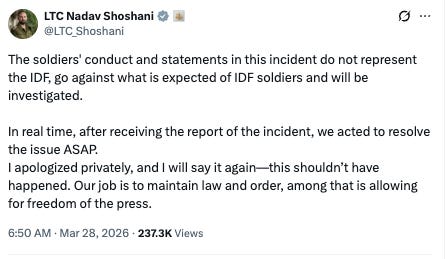
This is nearly identical to what Shoshani said in response to soldiers leading me into a settler ambush in October.
Wild that the crowdfunding for these settlements haven’t been taken down. It would be interesting to see someone do a deep dive into the payment processing behind Givechak.
Wait, so they take children who are in the foster system and place them in settler outposts?! Wtf??