
Annexation Breaks Containment
With a new package of cabinet decisions, Israel’s message to Palestinians in the West Bank is clear: take the money and run.
Israel’s Finance Minister Bezalel Smotrich has spent years playing a careful game of Operation with the West Bank—extracting one bureaucratic guardrail at a time, tightening Israel’s grip slowly enough to avoid setting off alarms. This week, it seems, he got a little too greedy. With a single package of cabinet decisions, Israel’s project of de facto annexation broke containment, spilling into global headlines:
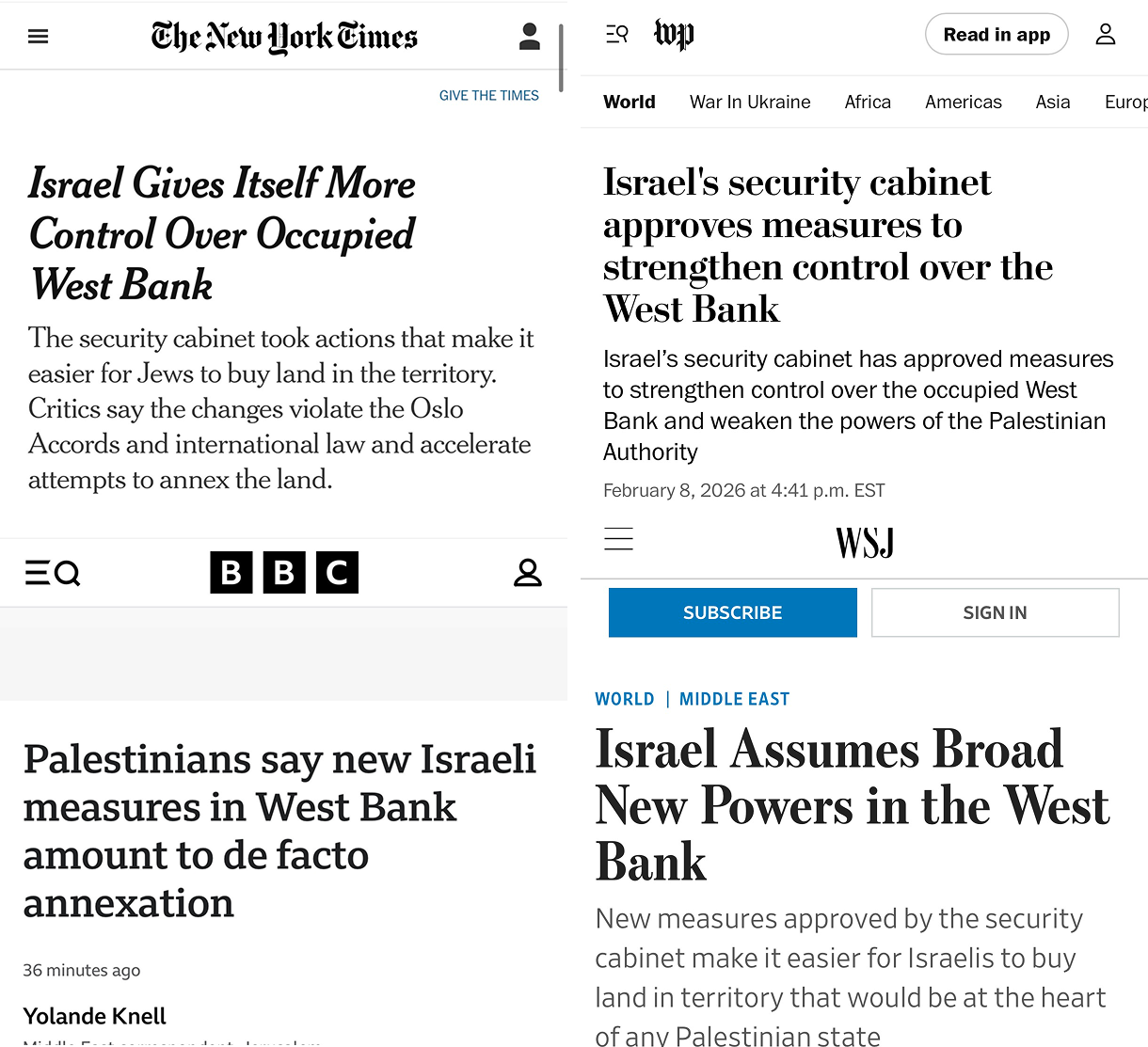
The New York Times noted that “with international attention largely focused [on Gaza], Israel has undertaken an unbridled expansion of Jewish settlements in the West Bank, which is under Israeli military rule. Military operations also have resulted in the biggest displacement of Palestinian civilians there since the Arab-Israeli war of 1967.”
I found this framing just a bit ironic, given that few institutions wield more influence over where international attention is directed than the Times itself.
In a parallel universe, where international attention had managed to multitask over the past three years—tracking not only the genocide in Gaza but also Israel’s unprecedented land grab in the West Bank—it might have noticed that Smotrich has telegraphed his every move. Over that period, he has quietly engineered a bureaucratic coup: transferring key authorities from the military to civilian ministries under his control, rewriting land registration and planning rules, and using administrative fiat to normalize what amounts to permanent Israeli sovereignty without a formal declaration. His project of de facto annexation maps strikingly closely onto his 2017 Decisive Plan, a canonical settler text that lays out three options for the “Arabs of Judea and Samaria”: (1) subjugation, (2) “voluntary” (or paid) emigration, or (3) defeat by force.
While Israel’s West Bank policies have long made subjugation and force routine, the new cabinet decisions shift the emphasis toward the second option: engineering the conditions under which emigration becomes the “choice,” and smoothing the path for it.
Here’s a brief summary of the cabinet decisions:
Opening the West Bank as a settler real estate market:
The cabinet removed key legal barriers that had restricted Israeli land purchases in the West Bank. Settlers will now be allowed to buy land directly from Palestinians without registering a local company and without obtaining a transaction permit—a safeguard that had been used to vet ownership claims, crack down on forged or coerced sales (a common feature of land purchases in occupied territory), and allow the Defense Ministry to block acquisitions in politically or militarily sensitive locations. At the same time, the cabinet instructed the military commander to open West Bank land registries to public inspection—records long kept classified—making it far easier for would-be purchasers to identify and track down owners.The effect is to hand enormous leverage to well-financed settlement groups, who can now acquire property deep inside Palestinian population centers and force the state’s hand after the fact, knowing the military is required to protect Israelis wherever they plant themselves. Settlers already do this by erecting illegal outposts near Palestinian villages and provoking violence that then triggers a military response; this gives them another, more formalized route to the same end.
As the Israeli journalist Amit Segal—considered by many to be Netanyahu’s stenographer—put it, Israel has “thrown open the doors to the Judean and Samarian real estate markets,” effectively privatizing annexation.
Yisrael Ganz, who leads the influential Yesha Settlement Council, shared a vision that sounds chillingly similar to the Trump-Kushner plan for Gaza: “The Cabinet decision means anyone can now buy land in Judea and Samaria… We want to develop commercial and industrial zones, health systems and more. It’s a huge opportunity for investors. Now is the time.”
It is not hard to imagine the next step: Palestinian land far beyond existing settlements, marketed and sold in board rooms and synagogues across the United States.
Reviving state-backed land purchases:
Alongside deregulating private settler purchases, the cabinet revived a mechanism allowing the state to buy land from Palestinians through the Custodian of Government Property in the West Bank, enabling direct government acquisition of Palestinian land for settlement use—a system last employed in the 1970s and 1980s.Israeli enforcement inside Areas A and B:
The cabinet authorized Israeli Civil Administration enforcement bodies to operate inside Areas A and B, territory that, under the Oslo II Accords, is meant to fall under Palestinian Authority civilian control. Israeli authorities will now be able to carry out demolitions and halt Palestinian development in these areas under broad justifications related to ostensible concerns around archaeology, heritage, water, and the environment.In the West Bank, where the occupation routinely undermines basic Palestinian municipal functions—from waste management to infrastructure maintenance—this policy becomes self-fulfilling. This is precisely what happened in Sebastia, where locals were forbidden from maintaining the archaeological ruins, leading to disrepair that was later used to justify their seizure.
Stripping Palestinian municipal authority around major religious sites:
The cabinet approved measures that effectively place major religious sites inside Palestinian cities under permanent Israeli planning and administrative control, enabling rapid settlement expansion. Specifically, it transferred planning and building authority at the Cave of the Patriarchs and in settlement areas within Hebron from the Palestinian municipality to Israel’s Civil Administration, in direct violation of the 1997 Hebron Protocol. It also approved the creation of a dedicated Israeli administration to manage Rachel’s Tomb in Bethlehem, allowing state budgets to flow directly to the site and the adjacent yeshiva.
Taken together, Israel’s broader strategy comes into focus: systematically making life unlivable while smoothing the path out of the West Bank.
“People act from motives of human comfort,” Smotrich wrote in his 2017 plan. “In a reality that allows easy and convenient emigration, and even provides logistical and financial aid to those interested in trying their luck in other countries—emigration will become far more widespread.” This, he insists, is not expulsion but optimization; after all, “Zionism was built based on population exchange.”
“The emigration we are talking about is planned, willing, and based on a desire for a better life.”
With the new cabinet decisions, the message is unmistakable: Your life here is only going to get worse—take the money and run.
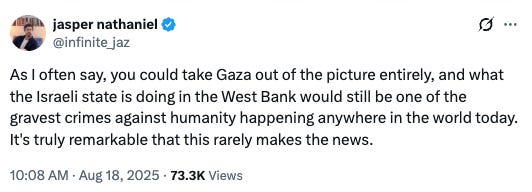
Within a day of the headlines breaking, the international condemnations poured in. The UN chief warned that Israel’s new West Bank measures are “eroding” the two-state horizon and reiterated that settlements are illegal; the EU called it another “step in the wrong direction”; and the UK said unilateral demographic/geographic changes are “wholly unacceptable,” urging reversal.
Despite this widespread coverage and outrage, Netanyahu has said nothing publicly about the cabinet decisions. That silence likely reflects his Wednesday meeting at the White House with Donald Trump, which is expected to focus on Iran and Gaza, not the West Bank, a subject Netanyahu would rather avoid. Trump has long treated formal annexation as a red line; in 2020, he balked when the UAE conditioned normalization on freezing annexation, forcing Netanyahu to quietly shelve his plans rather than jeopardize the Abraham Accords—Trump’s signature foreign-policy achievement from his first term.
This time, the alarms may be ringing, but softly enough to be safely ignored. The UAE issued a joint statement with other Arab states condemning Israel’s new moves, though—like the UN and European condemnations—it appears entirely toothless, coming without threats, consequences, or any suggestion of revisiting normalization. With the Accords effectively untouchable, Netanyahu has little to fear—and Trump little incentive to intervene.
That said, if anyone around Trump is actually invested in preserving his “peace plan,” which rested, at least nominally, on keeping the door open to Palestinian statehood, perhaps they will point out to him that this is a direct challenge to it.
For now, that seems unlikely. The White House responded on Monday with a fully boilerplate statement that made no reference to the new policies themselves: “President Trump has clearly stated that he does not support Israel annexing the West Bank. A stable West Bank keeps Israel secure and is in line with this administration’s goal to achieve peace in the region.” A day later, Trump told Axios, “I am against annexation. We have enough things to think about now. We don’t need to be dealing with the West Bank.”
Of course, preventing Trump from having to think about it or deal with it is the whole point. Smotrich’s project is engineered to provide plausible deniability against claims of formal annexation—advancing irreversible facts on the ground under the guise of niche policies, sparing Washington the need to acknowledge them. It allows the White House to issue broad statements like these without engaging the substance of what is happening—performative pressure that releases tension from the system while leaving it intact.
Here is Amit Segal again, saying the quiet part out loud:
Why is the plan so gradualist?
Well, for one, it avoids a dramatic confrontation in which Smotrich is caught with the proverbial murder weapon in hand. That makes it harder for international and domestic opposition to coalesce against all of the minor policies…
The approach also allows Smotrich to control the pace. At the moment, the majority in Israel does not support a major debate over annexation, so instead Smotrich can gather enough support for one cut, then another, and another—until annexation of the settlements, at the very least, becomes more of a reality than a risky prospect. All the while, Israel can dance around the international backlash annexation would inevitably cause.
I’m left with a grim premonition: Trump and Netanyahu sitting side by side for a presser after their Wednesday meeting. Trump turns to him and says, “He told me he’s not going to do annexation, isn’t that right?” Netanyahu smiles and nods, smug and delighted as ever, having conceded nothing at all.
In addition to these cabinet decisions, another major development in the West Bank last week went largely unnoticed. In 2024, I wrote that Israel was taking a major step toward de facto annexation of the West Bank by attempting to transfer authority over archaeological sites from the Civil Administration—the military body that nominally governs the territory—to the Antiquities Authority, which oversees heritage sites inside Israel. The goal was to shift another pillar of West Bank governance out of the military framework of occupation and into Israel’s civilian bureaucracy, further erasing the Green Line that separates Israel from its occupied territories.
But the bill stalled in the Knesset after running into opposition from Israeli archaeologists and even the Antiquities Authority itself—institutions that have long turned a blind eye to illegal excavations in occupied territory—who warned that formally tying their work to such illegal excavations could cause international boycotts to spill over onto law-abiding Israeli archaeologists. (As I wrote in 2024, this pattern is familiar in Israeli civil society, as meaningful protest against settler activity often emerges only when it begins to threaten Israelis themselves, rather than the Palestinians who have long borne its consequences.)
Last Tuesday, lawmakers found a workaround, advancing a bill to create the Judea and Samaria Heritage Authority: a parallel archaeological body that would operate only in the West Bank and be directly subordinate to Israel’s Minister of Heritage, Amihai Eliyahu, a close ally of Ben-Gvir’s. Its governing council would be composed entirely of Eliyahu’s political appointees, mirroring Smotrich’s 2023 creation of the Settlement Administration—a shadow civilian government inside the Defense Ministry that helped accelerate settlement construction by stripping away regulatory constraints.
Under the guise of “heritage protection,” the new Authority would be granted sweeping powers: declaring archaeological sites, conducting excavations, purchasing land, and—most critically—expropriating private property. The bill is deliberately vague about whether these powers extend into Areas A and B, but paired with the recent cabinet decisions, it suggests that Palestinian towns located near heritage sites could be forced to obtain Israeli approval to build homes, schools, or roads. With more than 6,000 archaeological sites scattered across the West Bank, such a transfer would not affect isolated ruins but Palestinian land almost everywhere, effectively giving Israel veto power over development and the authority to expropriate land deep into towns, villages, and farmland.
As the Israeli government advances annexation by a million cuts, settlers continue apace on the ground. In Umm al-Khair, where a settler murdered Awdah Hathaleen last year, the Palestinian community recently built a small soccer pitch for their children after years of demolition threats from Israeli soldiers and settlers. Days later, settlers showed up in the middle of the night and decorated it with Israeli flags and menorahs:

A week later—today—Israeli authorities returned with a stop-work order for the soccer field, a routine prelude to demolition:

In the Jordan Valley village of Fasa’il, settlers dumped a truckload of rotting dates outside a Palestinian family’s home and drove their cattle in to eat it and shit all over the yard, while Israeli soldiers and police stood by.

In Hebron, settlers poisoned three dogs belonging to a local Palestinian family:

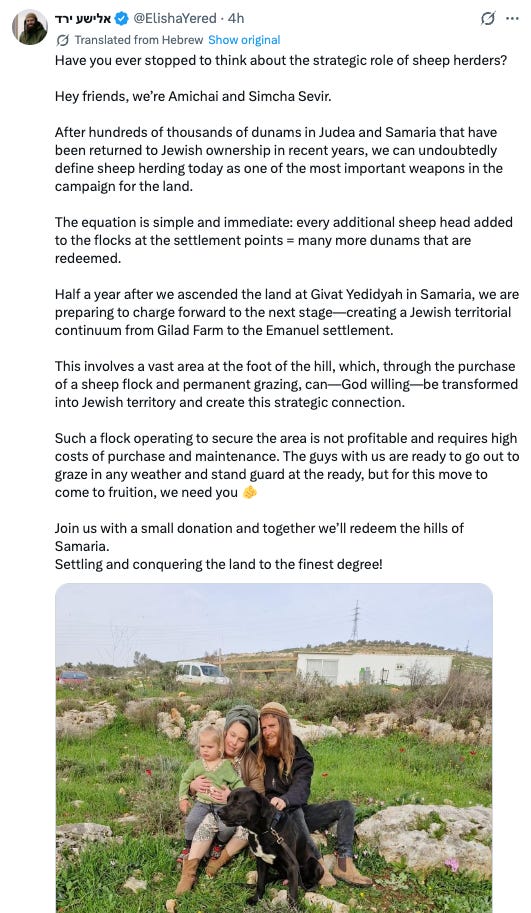
And here is Elisha Yered—the homicidal settler activist, recently celebrated at the Knesset—explaining why “sheep herding [is] one of the most important weapons in the campaign for the land”:
These daily acts of harassment and intimidation don’t begin to account for actual settler violence against Palestinians, which has escalated so sharply that even Israel’s state press can no longer wave it away. Israel’s Kan public broadcaster reported last week that three times more Palestinians than Jewish Israelis were injured in “terror attacks” in the West Bank in January.
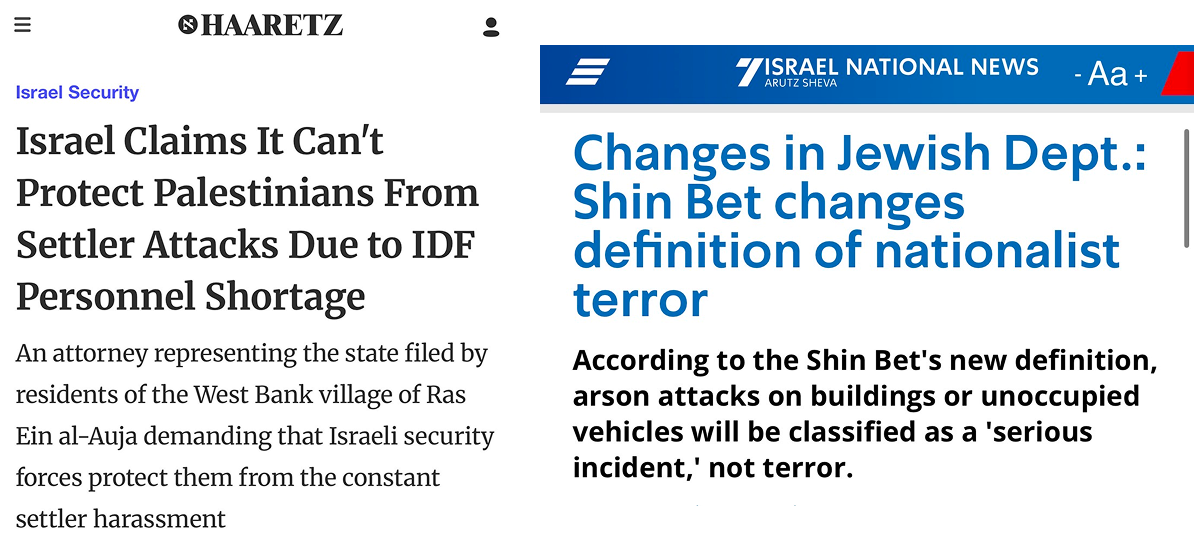
The Israeli government, meanwhile, continues to insist it is taking settler violence seriously, while doing everything in its power to facilitate it. On February 3, two headlines told the story. First, Israel’s Shin Bet quietly redefined Jewish nationalist terror, downgrading settler arson attacks on Palestinian homes and vehicles from “terrorism” to “serious incidents,” a bureaucratic shift that materially reduces enforcement resources. That same day, the state was arguing in court that it couldn’t protect a Palestinian village from settler attacks due to an IDF personnel shortage.
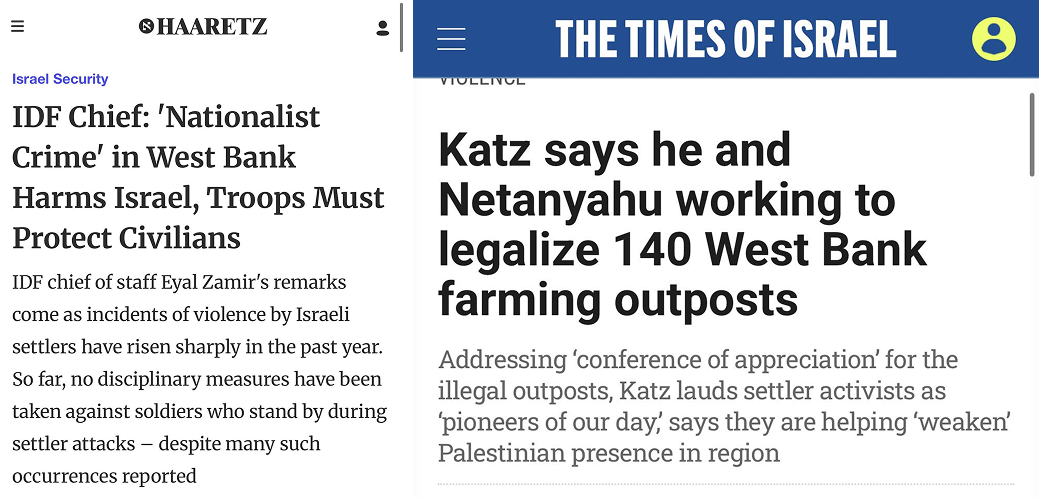
One day later, the IDF chief warned that settler violence was “harming Israel,” while, kilometers away, Defense Minister Israel Katz told a settler conference that he and Netanyahu were working to legalize 140 West Bank outposts—quite literally rewarding the most violent settlers by granting state recognition to land seized through violence.
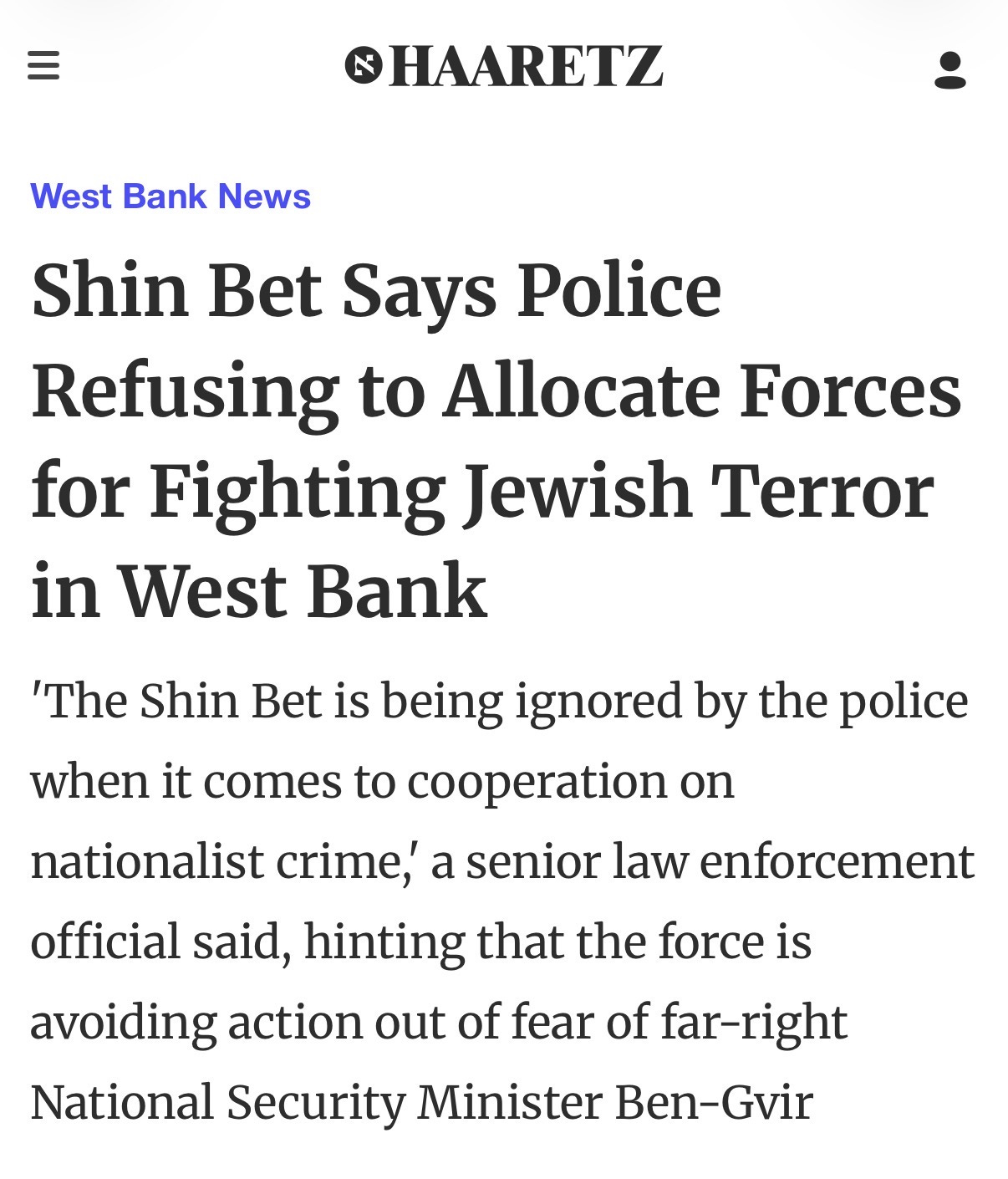
Then, to top it off, Shin Bet—having just cut its own resources for combating settler violence—complained that Israeli police refused to cooperate in fighting “nationalist crime,” reportedly out of fear of Ben Gvir:
For his own part, Israel’s Minister of Diaspora Affairs and Combating Antisemitism, Amichai Chikli, made clear what he sees as the real problem by announcing a new policy barring activists who enter the West Bank to document the violence.
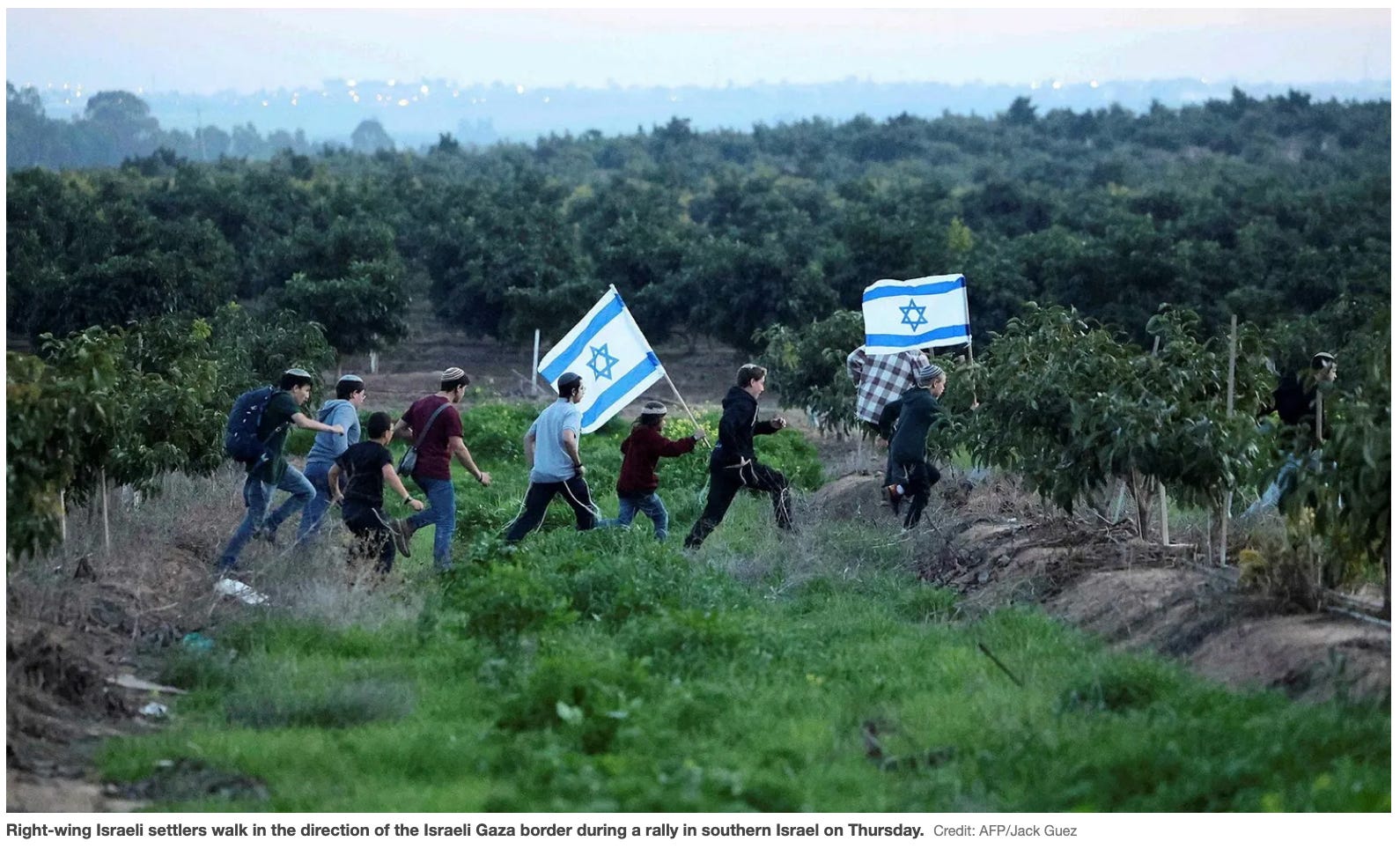
It bears noting that even as all of this unfolds in the West Bank, Israelis once again breached Gaza to lay the groundwork for resettlement.
And then there is the military violence. It’s difficult to convey the routine, ambient cruelty of the occupation to people who haven’t been to the West Bank. In 2024, I was drinking coffee in a café in Hebron when a soldier walked in, knocked a full tray of freshly baked cookies off the counter onto the floor, and walked out. That scene came back to me when I saw this video out of Qalqilya from February 8:
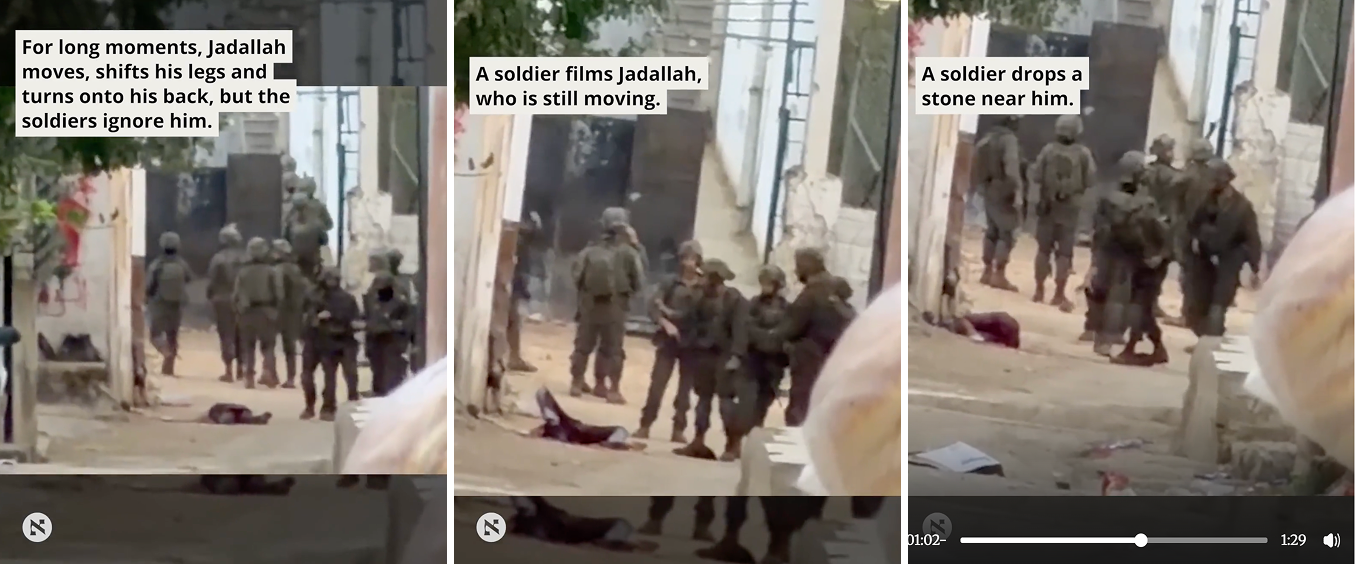
The Israeli journalist Amira Hass reported this week on a 14-year-old boy, Jad Jadallah, who was shot by Israeli paratroopers in the al-Fara refugee camp and left bleeding on the ground for at least 45 minutes. Video footage shows soldiers standing over him as he writhed, reached out for help, and threw his hat toward them in what appeared to be a desperate plea for attention. One soldier kicked the hat back. Another dropped a stone near the dying boy, a familiar step in the process of rewriting what had just happened. He died where he lay, and over two months later, Israel is still holding onto his body.
I want to end with something that happened here in the U.S. In my last post, Kristallnacht in the West Bank on Holocaust Remembrance Day, I wrote about Israel’s embrace of British white nationalist Tommy Robinson—part of a broader alliance with Europe’s far-right against what it insists is the “real” antisemitic threat of radical Islam.
On Thursday, Robinson shared a video on X that he claimed showed a “Christian preacher in America get[ting] beaten by Muslim’s [sic] for handing out bibles and preaching the gospel.”

In reality, Robinson’s clip was selectively edited to show only the response to a grotesque provocation—a common move, for what it’s worth, among settlers in the West Bank.
The video was filmed outside Sayfollah Musallet’s family ice cream shop in Tampa, at a memorial marking six months since settlers beat the 20-year-old Palestinian American to death in the West Bank. A group of “Christian preachers,” led by Christopher Svochak—who has been charged with hate crimes for previous incidents—showed up to the vigil and began shouting that Sayfollah was a “jihadist burning alongside Mohammed in hell.” You can hear all of this plainly in the video Svochak himself shared:
In Robinson’s selectively edited video, the young man seen being held back is Sayfollah’s younger brother, who cradled him for two hours as Sayf drifted in and out of consciousness on his family’s land, his breathing slowing, his skin turning blue. He stayed on the phone with their father, Kamel, begging him to send help. Ambulances arrived quickly, but Israeli soldiers blocked them from reaching the scene for more than two hours—standard operating procedure for the IDF. By the time they were allowed through, Sayfollah was dead.
The killing of a 20-year-old American by Israeli settlers, as you probably know, did not rise to the level of consequence from the U.S. government—or even to sustained attention from the media.
So why would a few tweaks to West Bank real estate policy?
what's interesting is that the preacher in that final video has 'jesus is king' written on his hoodie. it's a slogan that you'll often hear from nick fuentes and candace owens. it sounds kind of like vague christian nationalism, but the ideology is a fairly explicit attempt to delegitimize the 'hebrew' bible and the idea of 'judeo-christian values.' it's an incredibly anti-semitic strain of christianity. obviously, islamophobic as well. But more to your point, it points to the fact that the zionist alliance is built on deep contradictions that, ultimately, won't persist.
Thank you for this brilliant piece, translated in French here : https://zanzibar.substack.com/p/apres-le-confinement-lannexion