
Lay Down and Die
As settlers launch pogroms across the West Bank, Palestinians are told to quietly accept their fate.
Infinite Jaz exists because I believe reporting on Israel-Palestine, and the systems of power that shape it, should not be filtered through the priorities of billionaires and politically biased, risk-averse institutions.
But all of my reporting is self-funded, and it cannot continue without your support. If you believe in the importance of independent journalism, please consider becoming a paid subscriber—you’ll gain access to the full archive of subscriber-only reporting and help cover my upcoming reporting trips to the West Bank.
By now, you’ve probably heard about the latest escalation of violence in the West Bank. Not the escalation that I documented during the month I spent there, but the escalation of that escalation that kicked off right after I returned home.
On Friday, July 24, a mob of armed settlers set out from the Havat Gilad outpost—illegal under both international and Israeli law—for a “hike” through Nablus-adjacent Palestinian villages in Areas A and B, where, under Israeli law, they are forbidden from entering. Days earlier, Havat Gilad was badly burned by fires that Israeli authorities believe were started by a discarded cigarette, but which settlers blamed on Palestinian “terrorists”—a baseless accusation they used as justification for a spree of “revenge” attacks on nearby villages. Despite assessing that the fire was started unintentionally, the Israeli police arrested two Palestinians to placate the aggrieved settlers.
The hikers entered Tal, a Palestinian village that had, just a week earlier, seen one of its homes burned by settlers. So perhaps the residents weren’t so thrilled to see these uninvited guests. The machine guns may have had something to do with it, too. When locals came out to confront them, the settlers began beating them, aiming their weapons at them, and firing into the air. One of the Palestinians, Sheikh Farouk Ramadan, wrestled a gun away from a settler “security coordinator,” Benayahu Melet, and shot him dead as Melet reached for his pistol.
Ramadan then laid down the gun, and sometime later—at least an hour, according to this settler—a settler ordered an Israeli soldier to execute him, which he did. Three of Ramadan’s cousins, who were unarmed and lying on the ground, were then summarily executed one after another.
At some point during all this, an Israeli soldier was also killed—the settlers quickly blamed the Palestinians, but Israeli media is reporting he was killed by friendly fire.
Here’s a +972 investigation detailing the exact sequence of events in which the four members of the Ramadan family were killed:
In the video, Ramadan is seen getting up and starting to walk — slowly and unarmed — toward the soldiers stationed on a dirt path at the bottom of the hill. At the 4-second mark, the person filming or someone next to him shouts, “Shoot them already, kill them — do you want us to die?”
At the 14-second mark, it is clear that Ramadan is not holding a weapon in his right hand; a second later, it is evident that he is not holding a weapon in his left hand either.
We also know Ramadan was not armed at this point because the army had to search the area after the incident before finding the weapon. In another short video filmed after the incident, a settler urges the army to bring in D-9 bulldozers to raze the entire village so that the Palestinians “will hand over the weapon,” implying that they knew the weapon was missing rather than with Ramadan.
At the 29-second mark in the fourth video, Ramadan is seen crouching down on the ground. No shots can be heard at this point.
At the 42-second mark, someone off-camera shouts, “What are you waiting for? Shoot them already.” Five seconds later, a single gunshot can be heard. At the 50-second mark, a settler behind the camera says to someone next to him, “They’re shooting because I’m shouting,” before again yelling out “Shoot at anyone who comes close!”
At the 53-second mark, the wounded settler in black (seen struggling with a Palestinian on the ground in the third video) points at Ramadan and tells an armed Israeli man in civilian clothing, “Kill him!” Half a second later, the Israeli man fires two shots toward Ramadan.
Despite the plain fact that the killings occurred in a Palestinian village where Israelis are forbidden from entering—and that the dead included four defenseless Palestinians—Israeli leaders across the political spectrum wasted no time condemning the “severe terror attack” against the Israelis and calling for a massive military response.
From the Netanyahus and Ben-Gvirs of Israeli politics, this wasn’t the least bit surprising, of course. But if you’ve been following the mainstream coverage of Israel’s upcoming election, you might have been surprised to hear the same rhetoric coming from the country’s supposed liberal saviors, Gadi Eisenkot and Yair Golan.
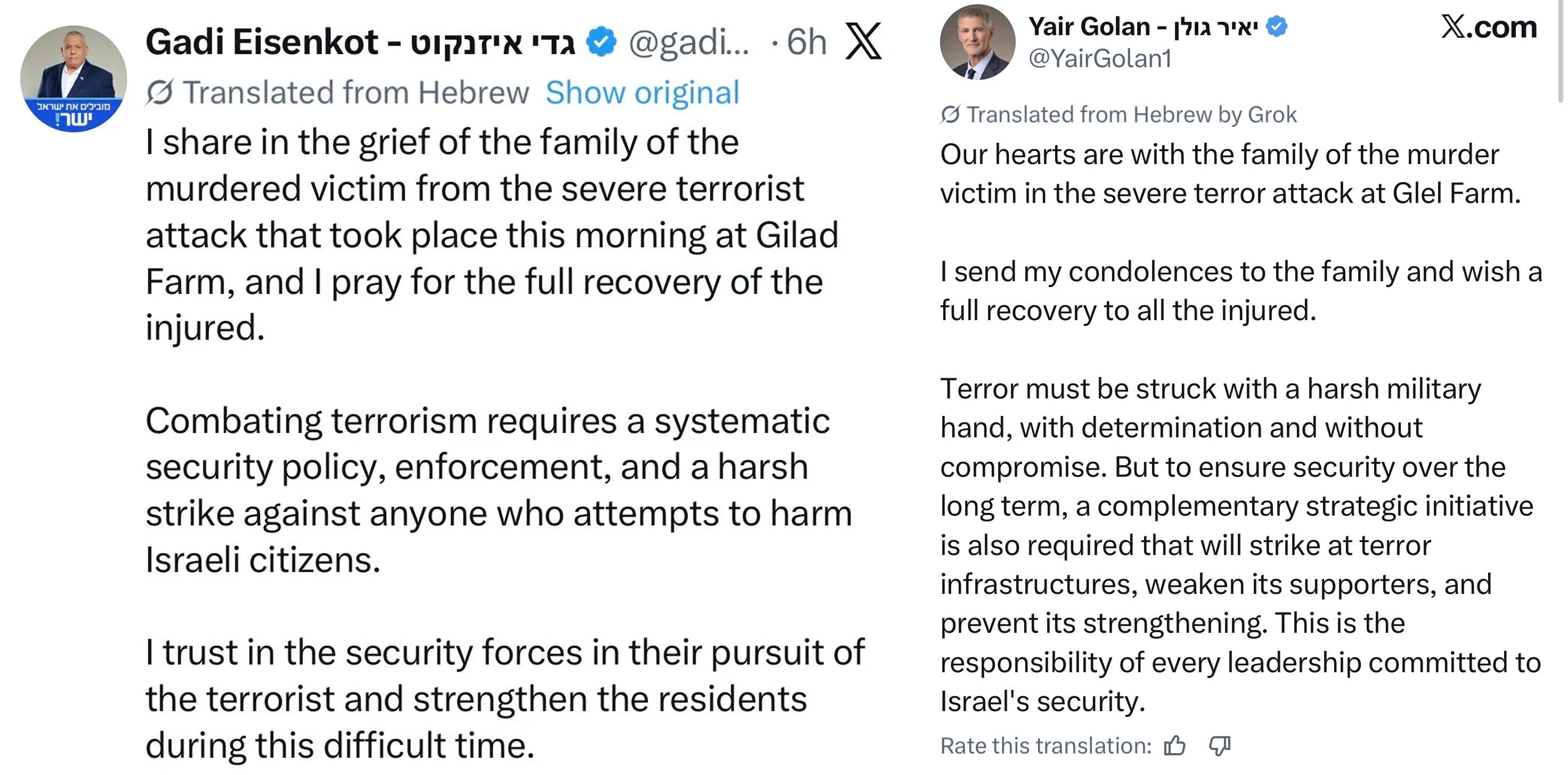
If nothing else, it was a useful reminder of what the Israeli center-left actually looks like these days. For context, Eisenkot, Netanyahu’s former IDF chief, developed the Dahiya Doctrine, which calls for the large-scale destruction of civilian infrastructure to pressure hostile governments. Like his political adversaries Netanyahu and Ben-Gvir, he refers to the West Bank by the messianic settler term “Judea and Samaria.” In April, he visited an infamously violent settler outpost—a clear gesture to its lawless leaders that, if the government changes hands and he takes power, they’ll still have his support. And, like every serious contender for the Israeli premiership, he is adamantly opposed to Palestinian statehood.
And so, in the immediate aftermath of the massacre in Tal, every plausible candidate to become Israel’s next prime minister converged on a narrative that effectively amounted to this: A group of Jewish settlers was innocently hiking through a Palestinian village when a local terrorist snatched a machine gun from one of them and murdered him in cold blood.
Don’t you just hate it when you break into someone’s home with a machine gun and then the homeowner steals your gun and commits an act of terror against you?
When trying to make sense of events like these, it’s helpful to listen to the settlers themselves, who often explain the euphemisms outright, unlike the cynical politicians who hide behind them. Here’s a prominent settler describing a “hike,” from a piece I wrote in March, The Most Predictable Place on Earth:
Just look at this group of settlers and reservist soldiers that took a field trip to a Palestinian village north of Hebron for target practice:
They’re having fun! And had somebody been shot and killed, you can bet the settlers would have claimed self-defense.
As this video made the rounds on X, the settler activist Elisha Yered shared a response: “A video in which any reasonable viewer can discern that it involves a group of hikers who were guarding the skies, hiking in a place that, according to the antisemitic Arabs… Jews are forbidden from entering, and therefore they were attacked by Arabs.”
What kind of a person goes on a “hike” like this? Well, at the funeral for Benayahu Melet, the settler killed in Tal, a eulogizer said that he “pushed relentlessly to conquer the area… fighting over every last dunam.”
More on settler “hiking”:
[Yered] explained that settler violence in any form is fundamentally an act of self-defense.
“There’s an enemy here who is waiting for the day it can murder me, and I’m not willing to be Kfar Azza,” he said, invoking a kibbutz attacked on October 7. “I will do everything I can to expel it, to hurt it.”
“There’s obvious self-defense,” he continued, but also: “the best defense is offense.”
…Yered goes further than the language of preemptive defense. Like most settlers—and much of the Israeli government—he believes Jews have an inherent right to the entirety of the West Bank, or “Judea and Samaria.” Settler incursions into Palestinian communities, he says, are designed to provoke violence that can then be met with overwhelming state force and eventual depopulation.
“Without question, we are initiating friction,” he said. “And we’re proud of that.”
Two weeks after I published that piece, a young settler out on a “land patrol,” Yehuda Sherman, was killed after his ATV collided with a Palestinian truck in the village of Beit Imrin. Despite all available evidence that the collision was an accident—and that the local Palestinians attempted to rescue the wounded settlers—it was immediately characterized as a terror attack and used to justify a wave of pogroms and land theft.
In A Young Settler Sacrificed for the Land, I wrote:
The extremist leaders of the settlement movement got exactly what they were looking for…
On a crowdfunding page for Shuva Yisrael Farms, the illegal outpost where Yehuda lived, its mission is described as being “the spearhead for activities throughout northern Samaria with the goal of seizing the lands and leaving them in Jewish hands.” At the funeral, a fellow hilltop settler described Yehuda’s work as part of a “strategic mission” to expel Palestinians from the West Bank and advance Jewish settlement in the territory…
Anyone who has spent time in Palestinian villages in the West Bank is familiar with the type of “land patrol” that Yehuda was conducting before his death. The settlers often arrive on state-gifted ATVs, circling village perimeters, chasing shepherds off their own farmland, sometimes brandishing weapons. At times they dismount, entering the villages themselves, even homes, getting in the faces of residents and activists, playing a high-stakes version of the child’s game I’m not touching you. In some cases, they are children, as young as ten or eleven. Some, like Yehuda, are born into long-established settler families—his grandfather made aliyah from Cleveland in 1973. Others are at-risk youth from within Israel, adopted by outpost communities, some of which are formally recognized as foster institutions, and conscripted as child soldiers in a war against their neighbors. In either case, when they show up in Palestinian communities, they are fishing for an opportunity to escalate—to (literally) call in the big guns…
In other words, “land patrols”—like the raison d’être of Yehuda’s outpost and the broader hilltop movement—are not meant to maintain stability, but to intimidate Palestinians into leaving, or provoke a response that can then be used to justify overwhelming force and, ultimately, expulsion.
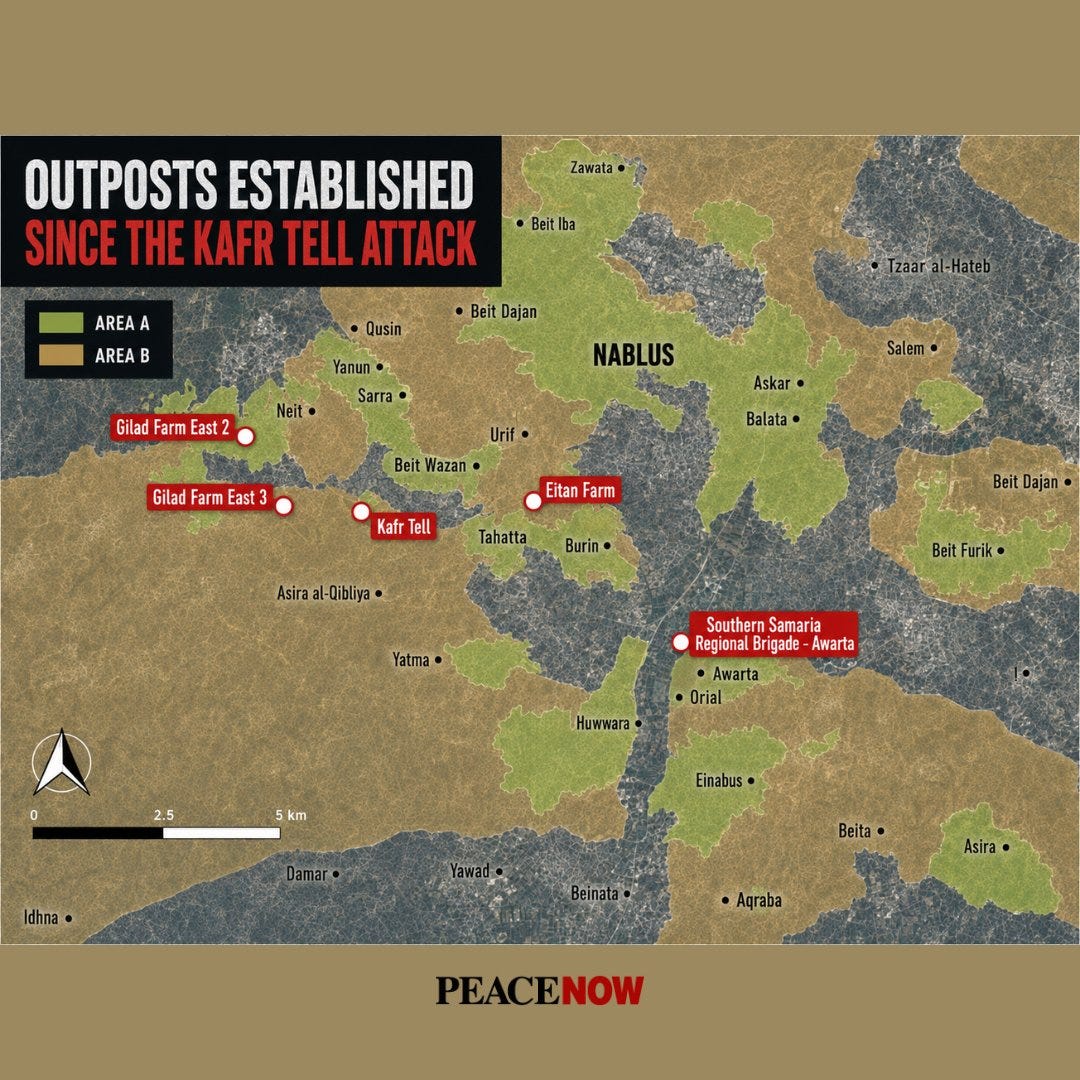
And so, Yehuda’s corpse immediately became grist for the mill—a “sacrifice,” as his own father called him—as settlers fanned out and established five new outposts in a matter of days, exceeding his father’s goal of three. Three of them were in PA-controlled Area A, effectively heeding Smotrich’s call to erase Oslo’s lines.
Back to the Tal massacre. Melet’s wife, eulogizing him, acknowledged that before he violated Israeli law by entering Tal, he was busy violating Israeli law by building illegal outposts—and that several more would be illegally built in his honor: “Just this morning you were working on establishing two new settlement outposts, and from there you were called to the incident… At the site of the murder there will be Jewish communities, flourishing and thriving.”
Melet’s father said, “We are not interested in Areas A, B and C… it is not our language, it is not our world. We want settlement throughout all of the Land of Israel. And the Land of Israel does not end only with the State of Israel, but also includes the Gaza Strip and parts liberated from Lebanon — these are parts of the precious and beloved Land of Israel.”
And here his brother—who, I chillingly discovered, is Amishav Melet, the infamously violent settler leader in Turmus’ayya who attacked me last October—responding to a video of the IDF demolishing Ramadan’s home: “Free us from these shows. Give the widow and orphans the homes. Give the released soldiers free plots on the ruins of this murderers’ village. Give us a real victory - conquest, expulsion, and settlement!”
Within hours of the shooting, the Israeli military was launching raids across the West Bank, tightening its siege on vulnerable communities, demolishing homes, and brutalizing and arresting hundreds of Palestinians. With the explicit backing of the government, settlers launched their own wave of terror across the West Bank.
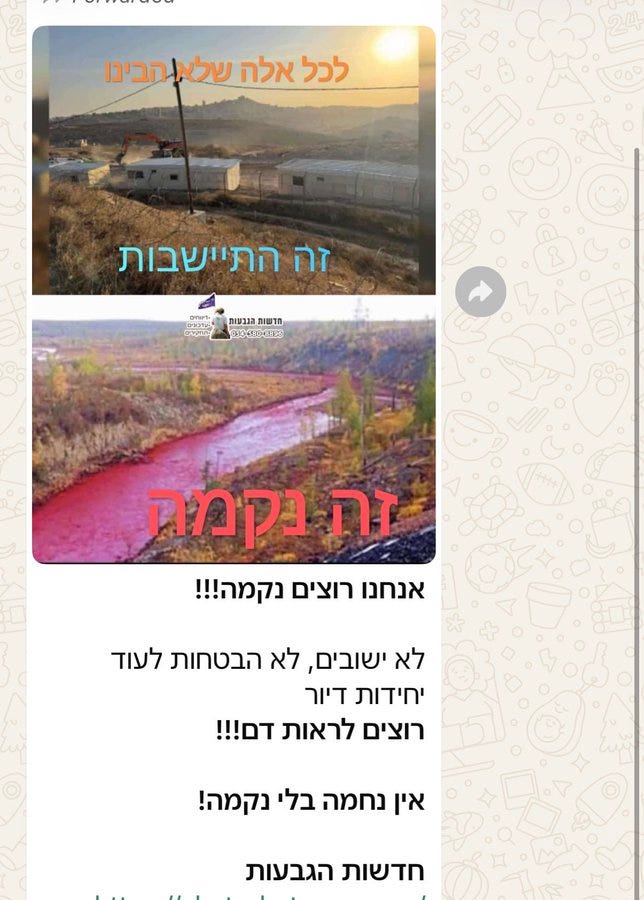
By Monday, settlers and soldiers had raided some 30 villages, wounded dozens, and detained hundreds, including over 100 people from Tal alone. Soldiers pulled Farouk Ramadan’s wounded brother straight out of his hospital bed to arrest him, and a pregnant woman delivered a stillborn after Israeli forces held her ambulance at a checkpoint.
Here is Netanyahu, giving the whole game away:
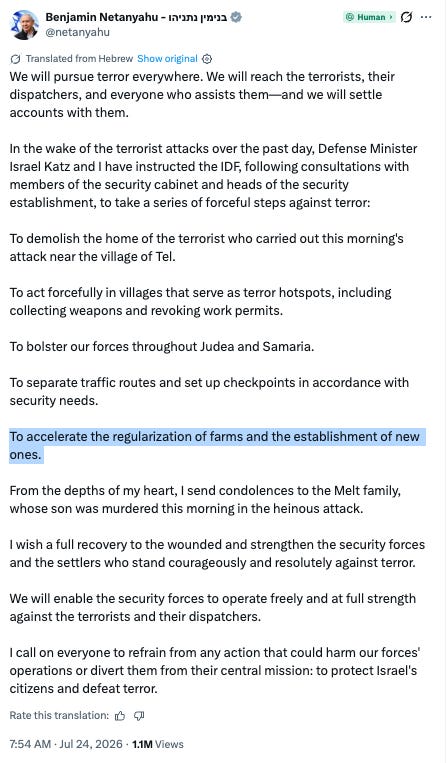
The whole process, as I’ve written many times, is entirely predictable:
The army partners with settler leaders to plan and approve new outposts—mapping sites, coordinating with commanders, and issuing orders for how they will be secured.
Settlers then establish the outposts themselves—planting flags and caravans on Palestinian land and cutting access roads.
The state provides them with military protection; some are gifted guns, drones, ATVs, other military-grade gear, money, and infrastructure.
The settlers fan out from their new outposts [often on “hikes” or “land patrols”] terrorizing neighboring villages, often with soldiers either standing alongside them or clearing the way, emptying the land of Palestinians—more than 70 rural communities have been violently expelled since October 7. [Occasionally—like in Tal—settlers provoke a violent response from Palestinians, which is then used as justification for further violent ethnic cleansing.]
When the footage gets bad enough, Israeli leaders issue condemnations and, on rare occasions, arrest a settler foot soldier but never the architects.
Then, quietly, the state incorporates the gains—retroactively legalizing the outposts, paving the roads, and absorbing the stolen land into the ever-expanding settlement project.
Earlier this month, Avi Bluth—the highest-ranking IDF officer in the West Bank—just came right out and said that establishing settler outposts is part of the IDF’s doctrine:
Drop Site’s Zena Tahhan confirmed the pattern held exactly as expected: within three days of the killings in Tal, settlers and soldiers had established at least six new outposts on Palestinian land—including one at the site of the shooting, after uprooting hundreds of olive trees. Without a doubt, some of these outposts will eventually be retroactively authorized as legal settlements, just as Netanyahu promised.
In the days and weeks before this latest massacre, I’d been writing and speaking about the excruciating decisions Palestinians face when confronting settler attacks—a damned-if-you-do, damned-if-you-don’t scenario in which fighting back can mean death and destruction, and not fighting back might mean the same. With Tal, we saw what happens when a Palestinian fights back.
Among the villages attacked in the revenge spree was Qusra, where a mosque was burned and vandalized with graffiti reading, “WE WILL DECORATE THE LAND OF ISRAEL WITH BLOOD - REVENGE.” Here’s what I wrote about my time in Qusra last month:
I traveled southeast to Qusra, where settlers had recently stolen a Palestinian home on the peak of the highest hill and were using it as a launchpad for attacks on the village. In February, they beat two Israeli activists, including an elderly woman, nearly to death, cracking their skulls with clubs. In March, they shot a Palestinian man dead and nearly stabbed his father to death. The surviving members of that family, strawberry farmers, have imprisoned themselves inside a cage to keep the settlers out.
I stayed with the shebab in another home on the stolen hill, where they kept a 24/7 watch. The attacks were constant. They went on all night. A pickup truck full of settlers arrived and unloaded a flatbed of large stones on us. They came with clubs and knives. Eventually, the army arrived. Soldiers chatted with the attacking settlers, smoked cigarettes with them, before coming to the home and throwing four Palestinian men against the wall. They were there to investigate the settlers’ claims that the Palestinians had thrown rocks at them. They had no answer when I asked why the settlers were allowed to live in a stolen home and attack locals from it—but the stones allegedly thrown in response were treated as a matter of grave concern.
Is there a reasonable person on earth who could watch this exchange and conclude that the soldiers were in the right? I don’t think so. And that’s why I believe it is, in fact, possible to change the mainstream discourse around the Palestinian right to resist. The media and political establishment have completely normalized the idea that a Palestinian with a gun—or, in many cases, a stone—is inherently a terrorist, even if that gun is wrestled from an attacker, or the stone is being used to fend off an attack. That assumption is essential to Israel’s ability to violently ethnically cleanse the land from the river to the sea without meaningful international intervention. But when you discard that assumption and look at the reality of what’s happening on the ground, it becomes remarkably simple: Of course Palestinians have the right to defend themselves. There is no other place in the world where a people would be expected to respond nonviolently to this kind of relentless, state-backed terror.
In the meantime, the IDF’s chief concern, rather than disarming the violent settlers, is ensuring that their Palestinian victims remain unable to defend themselves. From the Times of Israel:
In response to the violence, there are signs that Palestinians are organizing themselves to fend off attacks.
In recent weeks, the Israeli army has identified increasing activity by watch groups made up of village volunteers who patrol their communities and warn residents of approaching settlers.
In towns with patrols, volunteers gather nightly, using flashlights to scan the area for settlers. When someone spots a group of settlers, they alert others by phone, mobilizing additional residents to the area to confront and push the settlers back…
Palestinians have been unwilling to discuss the groups with the media, but a senior Israeli military official, speaking on condition of anonymity, told The Times of Israel that some 70 of these watch groups currently exist.
“As of now, they are not armed,” the officer said. However, the IDF is concerned that some of these groups could eventually arm themselves, raising fears that future confrontations between settlers and Palestinians could become significantly more violent.
“This is one of our focus areas, to ensure that an incident of this kind does not happen,” the officer said.
This past Friday, one week after the Tal massacre, more than 100 settlers, many of them armed, returned to the village for a “memorial hike,” raiding a building and vandalizing a cemetery.
The settlers then provoked another confrontation with villagers, and the IDF responded by shooting another Palestinian.
I’d like to give the settlers the final word.
Last week, the BBC’s Lucy Williamson was able to get inside the Havat Gilad outpost and speak to Yehuda Shimon, “a lawyer with an organisation that represents Israelis arrested for violence against Palestinians.” Shimon defended the wave of settler attacks that followed the Tal massacre, saying, “I think now, after they killed one Israeli, we need to kill all the people in Tal and Sarra, even Jit and Farata.” When Williamson pointed out that he was equating one Jewish life with hundreds or thousands of Palestinian lives, he replied: “No… millions. One Jewish life, it’s 10 million [Palestinians].” Asked whether that view was racist, he answered simply: “Yes, I know. But this is the truth, because God chose us,” before dismissing international law on the grounds that the Bible grants Jews the right to the land.
Later in the interview, Shimon said Palestinians in the West Bank have three choices: accept Israeli rule, leave, or be killed. “If you don’t want to make peace with us, and you don’t want to get out,” he said, “I don’t have a choice: I must kill you, and I kill you all.”
All of this is not some fringe settler fantasy. It is, more or less, official Israeli policy.
If you’ve spent any time with settlers, you’ve likely heard these three choices before. They are drawn almost verbatim from Smotrich’s 2017 “Decisive Plan”—the canonical settler blueprint for creating a decisive moment, perhaps even a holy war, that would secure final Jewish control over what they call Judea and Samaria.
The question is: Do the Palestinians have a right to defend themselves in such a war? Or should they just lay down and die?
If you’ve made it this far, consider upgrading to a paid subscription at 20% off.
A few recent media hits in case you missed them:
Chapo Trap House: The Hills Have Eyes 2. Here’s one clip, in which I argue that two-state solution liberals must come to the table with a plan to go to war with Israel:
American Prestige livestream. Among other things, we take a deeper dive into Israeli politics, and how it relates to what’s happening in the West Bank.
Breaking Points: On “liberal Zionism” and Trump’s meeting with Netanyahu
BreakThrough News with Rania Khalek: Terror, Pogroms & Land Theft: Inside Israel’s Final Push to Take the West Bank
I cannot stop being astonished at seeing the descendants of people who escaped programs or the Holocaust turning into Nazis.
I too am Jewish and I cannot stomach seeing this extreme lack of humanity.
Why has it happened and what will stop it?
This stuff breaks my heart. The Israeli settlers are the terrorists in these Palestinian villages where they are prohibited to even be. They are living through what Americans experienced during the black slavery period where white people could shoot and kill as many blacks and get away with it with no accountability.