
He retorted, narrowing his eyes.
The Free Press prints a racist lie to fit a prefab narrative; Israel authorizes 34 settlements under cover of condemnations.
Note to readers: I’ve recently taken the plunge into full-time writing and reporting, leaving behind the work that’s paid my bills for the past fifteen years. It’s both exciting and unnerving—journalism isn’t exactly a gold mine these days, and every bit of my reporting is self-funded. I travel with no crew, no security team—just me. But, at the risk of sounding sentimental, I’ve never felt more certain of my purpose.
Infinite Jaz exists because I believe reporting on Israel-Palestine, and the systems of power that shape it, should not be filtered through the priorities of billionaires and politically biased, risk-averse institutions.
But it cannot continue without your support. If my work has mattered to you, please consider becoming a paid subscriber—you’ll gain access to the full archive of subscriber-only reporting and help cover my upcoming reporting trips to the West Bank.
For a limited time, I’m offering 20% off for an annual commitment—just over $5 per month:
A very funny and ridiculous but also not-funny and ominous thing happened on the internet this past week. Olivia Reingold of The Free Press—owned by CBS’s Bari Weiss—covered a much-talked-about political rally, in which Michigan Democratic Senate candidate Abdul El-Sayed stumped with the popular left-wing streamer Hasan Piker. The announcement of the event had already generated a three-week news cycle, in which Piker—a proud anti-Zionist who is doing more than anyone to combat the real antisemitism festering in dark corners of the internet—was smeared as antisemitic. As Trump threatened to end a 3,000-year-old civilization, prominent pundits and Democrats lined up to criticize El-Sayed for sharing a stage with Hasan Piker.
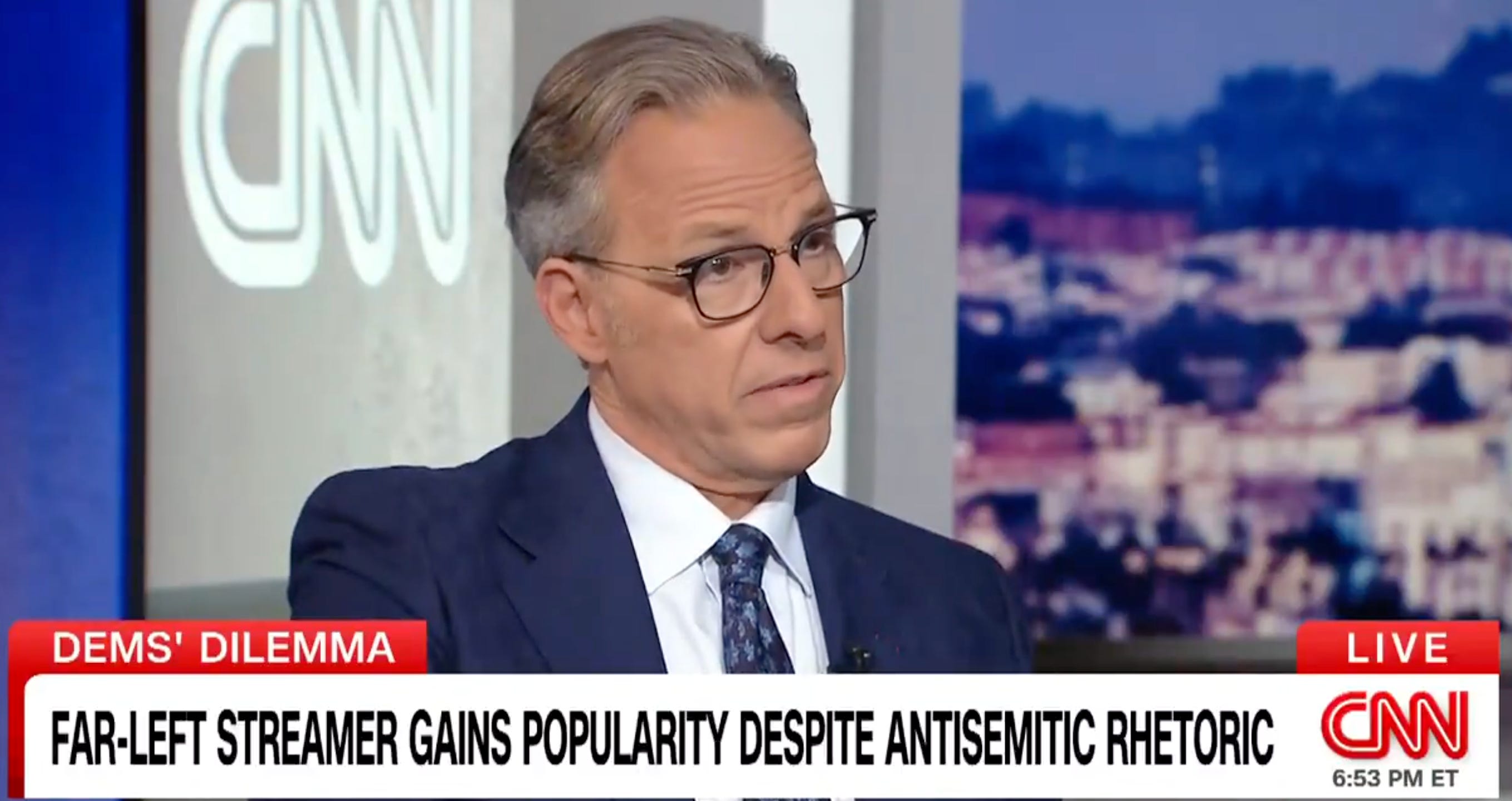
During the actual event, footage of an exchange between Reingold and El-Sayed—coming after he had already fielded a barrage of hostile questions from her—went viral.
The internet, which has recently caught on to the fact that the question of whether “a state has a right to exist” doesn’t actually mean anything, was quick to point out that Reingold froze when asked to define what she herself had asked.
Here is how Reingold characterized the interaction the following day (the same language was used in her Free Press article, Michigan Gets Its Own Mamdani):
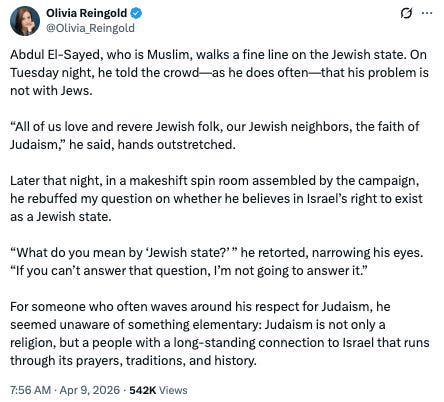
You may have noticed that Reingold, who is Jewish1, misquoted El-Sayed, something that The Free Press later corrected:

But there’s another, more telling detail they failed to correct. To see it, you have to set aside, for a moment, the awful prose of “he retorted, narrowing his eyes”—young writers, please note that “he said” was right there—and focus instead on its accuracy:
Do you see any narrowing of his eyes? Of course not. If anything, El-Sayed’s expression is extraordinarily warm, given the rhetorical game he’s being subjected to—and the constant defamations he’s forced to respond to. In my culture, we’d say that he’s acting here like a mensch.
After I pointed this out on X, many people had fun with it. A few of my favorites:
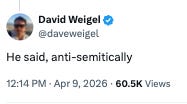
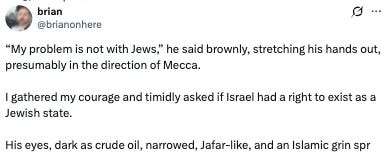
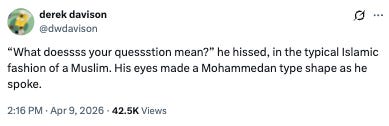
One more, since I really couldn’t help myself:
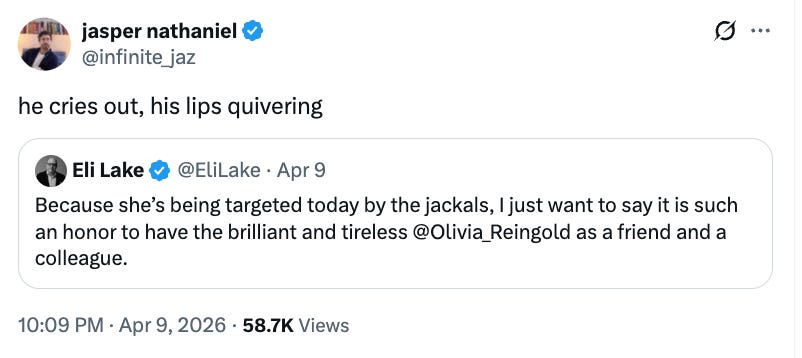
Okay, now that the jokes are out of the way, it’s worth being precise about what exactly happened here: Olivia Reingold, a star reporter for what is effectively a CBS-affiliate, fabricated a detail in her story from whole cloth to portray El-Sayed as a nefarious, antisemitic Muslim. For actual reporters, this is not trivial. It is, in fact, a very big deal: lying to advance your narrative is a cardinal sin in our field. These are the details that make stories come to life, and Reingold’s lie that El-Sayed “narrowed his eyes” is a perfect one to go alongside the relentless Islamophobic characterization of men with names like Hasan Piker and Abdul El-Sayed.
I’ve had many true details cut from stories by editors on the grounds that I couldn’t prove without a shadow of a doubt that they actually happened—through visual evidence, corroborating witnesses, or confirmation from the subject themselves—even though the editors believed me. Serious publications observe an abundance of caution to avoid having to issue corrections.
Reingold, for her part, attended Columbia Journalism School, where she presumably learned the same cautionary tales I did at NYU, about reporters like Jayson Blair and Stephen Glass, whose careers ended in disgrace after they were exposed as serial fabulists. This is apparently not a concern when working at The Free Press. The fact that the publication left this fabrication in—despite a viral video that readily disproves it—suggests that Bari Weiss, who has rapidly become one of the most powerful figures in American media, is willing to sideline the truth when it conflicts with a prefab narrative.
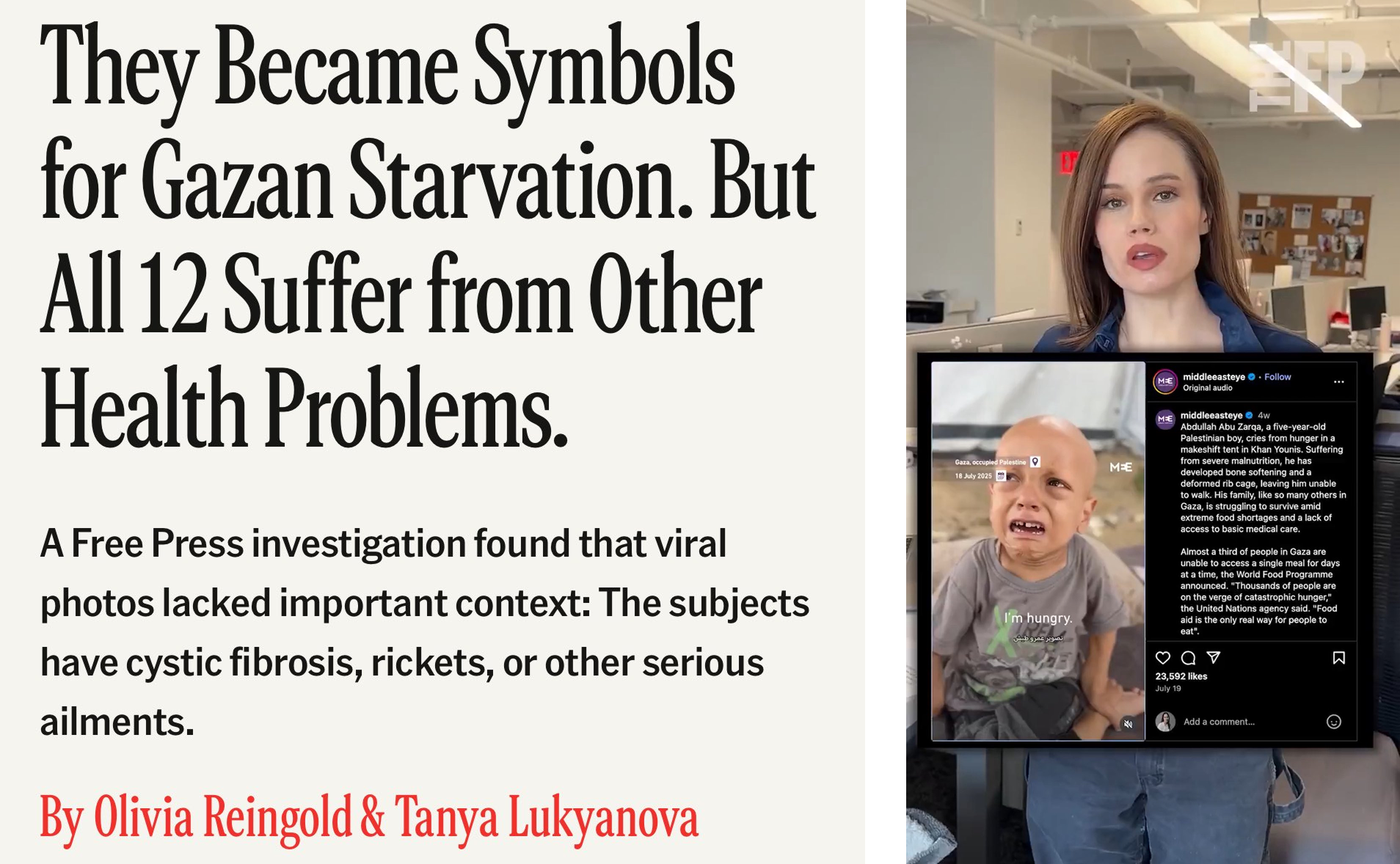
The irony is hard to miss coming from a reporter and outlet that accused the media of lying about the Gaza famine by profiling starving children with preexisting conditions.
The episode is a good microcosm of the broader antisemitism hysteria since October 7. On the journalism front, Adam Johnson made a good point about how writers like Reingold have boxed themselves into a corner with their own delusional narratives, leaving them reliant on imagined details that inevitably read as flowery and unreal.
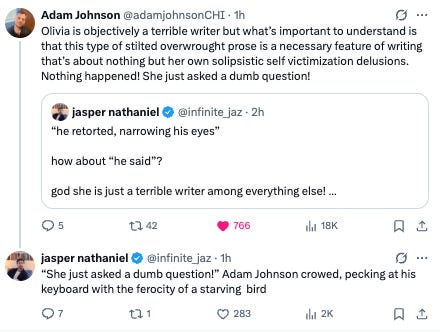
But I am being optimistic—the general news-following public is not reading lines like this and immediately recognizing them as unreal, but instead taking them at face value. Such distortions have flourished for decades in the mainstream media, calcifying racist narratives into conventional wisdom.
Which leads me to the even graver issue—and please bear with me through this moderate leap—of Israel’s ethnic cleansing of the West Bank, and the way it is routinely obscured through toothless condemnations of settler violence.
For years, I’ve written about how ritual condemnations of settler violence serve as a pressure release valve for Israel’s broader project of ethnic cleansing in the occupied West Bank. When footage grows bad enough and international outrage builds, Israeli officials and their allies step out to placate their critics—Yes, we agree with you, this is bad, but they’re just a few bad apples!—quarantining the supposed “fringe youth” who commit the violent acts. The more “liberal” among the tsk-tskers, like NYC Congressmen Dan Goldman and Richie Torres, call on the Israeli government to prosecute the violent settlers, obscuring the basic fact that this is the same government that funds, arms, and protects them. The call, in other words, is for the foxes to get serious about henhouse security.
The violence has been so bad over the past month that even some settler leaders joined in on the condemnations:
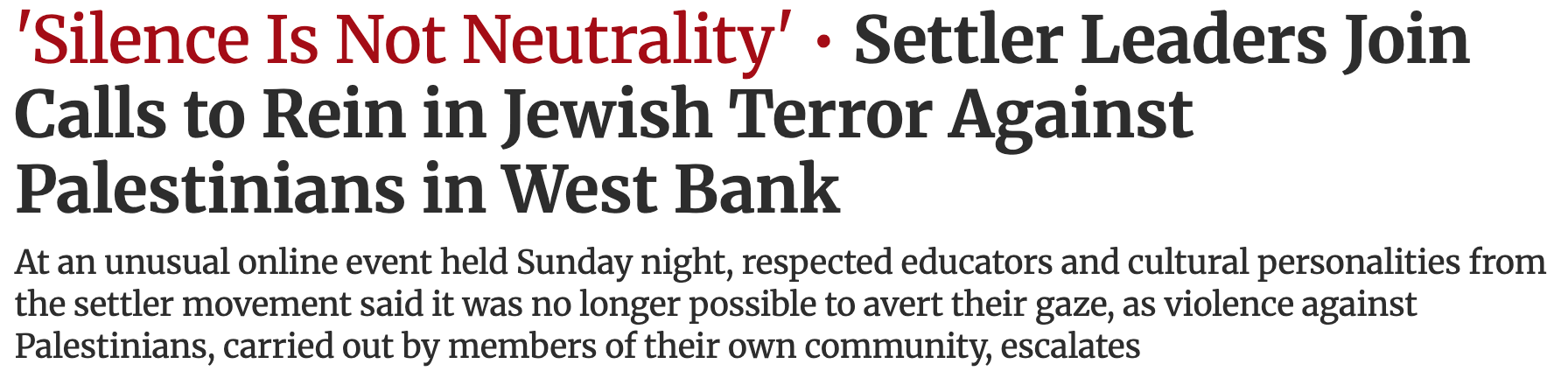
The event was called, “Yes to the Land of Israel. No to Violence,” begging the question: How do they propose to take over the ‘Land of Israel,’ where three million Palestinians live, without violence?
Well, they can’t, and that’s where the Israeli government comes in: as the condemnations calm the outrage and attention fades, the cabinet quietly rewards the settlers by authorizing their illegal gains, approving new settlements on the land they’ve violently emptied of Palestinians. This is why the settlers are known to their supporters as “Jewish pioneers,” pushing the frontiers of the Land of Israel—and why settler leaders roll their eyes and accuse their pro-Israel critics of hypocrisy, knowing they’re simply doing the state’s dirty work when they terrorize defenseless Palestinians.
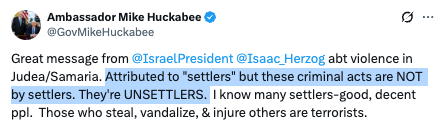
Well, here it is playing out in plain sight. Amid the explosion of settler violence during the war on Iran and the ensuing wave of condemnations, the Israeli cabinet quietly approved a record-breaking number of new settlements, including many that began as bases of settler terror in the northern West Bank, the epicenter of the past few weeks’ pogroms. These 34 new settlements will now be fast-tracked for state support, with access to funding, public utilities, municipal services, building permits, and more. It’s the largest batch ever authorized at one time, bringing the total under the current government to 103. By contrast, in the three decades between the Oslo Accords and the establishment of the new government in late 2022, six new settlements were formally approved.
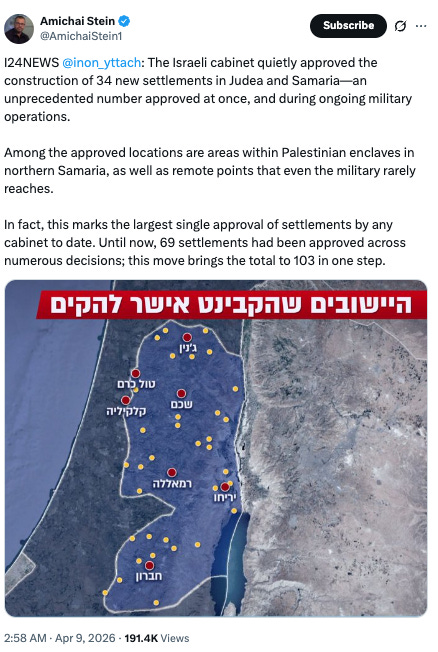
At a ceremony for one of the new settlements, Finance Minister Bezalel Smotrich congratulated the “twelve core families of pioneers,” a reference to the settlers who broke Israeli law to establish an illegal outpost and waited out the clock for the government’s rubber stamp, which had finally come. He also promised that the settlement movement would push into Gaza, Lebanon, and Syria.
Elisha Yered, the Hilltop Youth settler leader accused of murder (whom I write about often), celebrated the announcement as a “historic” breakthrough—not just for the number of settlements approved, but for their strategic placement deep in the northern West Bank, the same region where he’s led a campaign of terror in recent weeks. He described it as evidence that the government recognizes that the settlers are nearing completion of the takeover of Area C, and are now preparing the ground for the next phase: pushing settlements into Areas A and B. Yes to the Land of Israel!
“The order of the hour is to storm the next goal of the settlement,” Yered wrote. “To abolish the Oslo Accords with your feet!”
On Thursday, Israel’s Minister of Diaspora Affairs and Combating Antisemitism, Amichai Chikli, concurred, visiting an infamously violent outpost deep in Area B and declaring that it was “time to wean off” the Oslo Accords. (I think I can speak for Jews across the diaspora in saying: thank you, sir, for combating antisemitism.)
And Haaretz reported that the new chief of the Shin Bet—the agency ostensibly responsible for cracking down on settler violence—does not refer to attacks on Palestinians in the West Bank as “Jewish terror,” but rather as “cases of friction” between Jews and Palestinians. Notably, he’s using the exact same euphemism as Elisha Yered, who has openly described their violent incursions into Palestinian villages as attempts to “generate friction.”
So my question is this: Will Dan Goldman, Richie Torres, and even those “respected settler leaders” clamoring for a “peaceful takeover” of the Land of Israel—all of whom condemned settler violence last month—acknowledge that the Israeli government, rather than heed their calls to crack down on the perpetrators, has responded by rewarding them for their acts of terror? Doubtful!
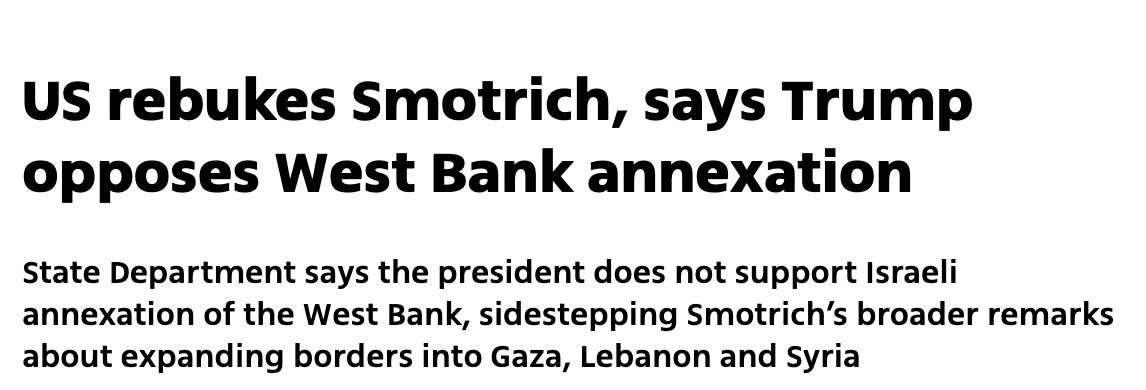
YNet reported that “According to two officials familiar with the matter, the approval of the new settlements was kept under wraps during the war at the request of the United States.” This is, of course, the reason Israel is undertaking a de facto annexation in the first place: Jewish control of the West Bank continues expanding unabated without crossing the “red line” of formal annexation set by the U.S., Europe, and several Gulf states. The hollow condemnations can be swatted away with no fear of material consequences.
I want to revisit the viral CNN moment from last month, which has become a neat case study in how all this works. First, a refresher:
In the middle of the night on March 26, settlers stormed the Palestinian village of Tayasir, beating 75-year-old Abdullah Daraghmeh while he slept, breaking his skull and several bones in his face, and knocking several of his teeth out. By morning, the settlers had set up a new outpost.
The following day, as CNN’s Jeremy Diamond visited Tayasir to report on the attack, he and his cameraman were accosted by IDF soldiers. The soldiers told him, in no uncertain terms, that they were seeking revenge for the death of a young settler, that they believed Jews are entitled to the whole West Bank, and that they were working to help turn the illegal outpost into a legal settlement—the exact process I have just described that culminates in a formal government authorization.
After the footage went viral, the IDF quickly condemned the comments, saying they do not represent the IDF, and announced the suspension of the battalion. They also said that the outpost had been evacuated.
Here’s what happened when the cameras stopped rolling:
The next day, settlers returned to the evacuated outpost to rebuild it and terrorize Tayasir once again, wounding four Palestinians and torching homes and cars. Soldiers were nowhere to be found—except days later, when they joined the settlers in their outpost rebuilding efforts.
Attacks on Tayasir continued. On April 7, during a settler incursion backed by the IDF, a soldier shot and killed a young man, Alaa Khaled Sbiah, who had come out to defend his village.
Step six has not happened yet, but a question for the future: If (and when) this outpost is formally authorized as a settlement, will the media connect it to its history of violence?
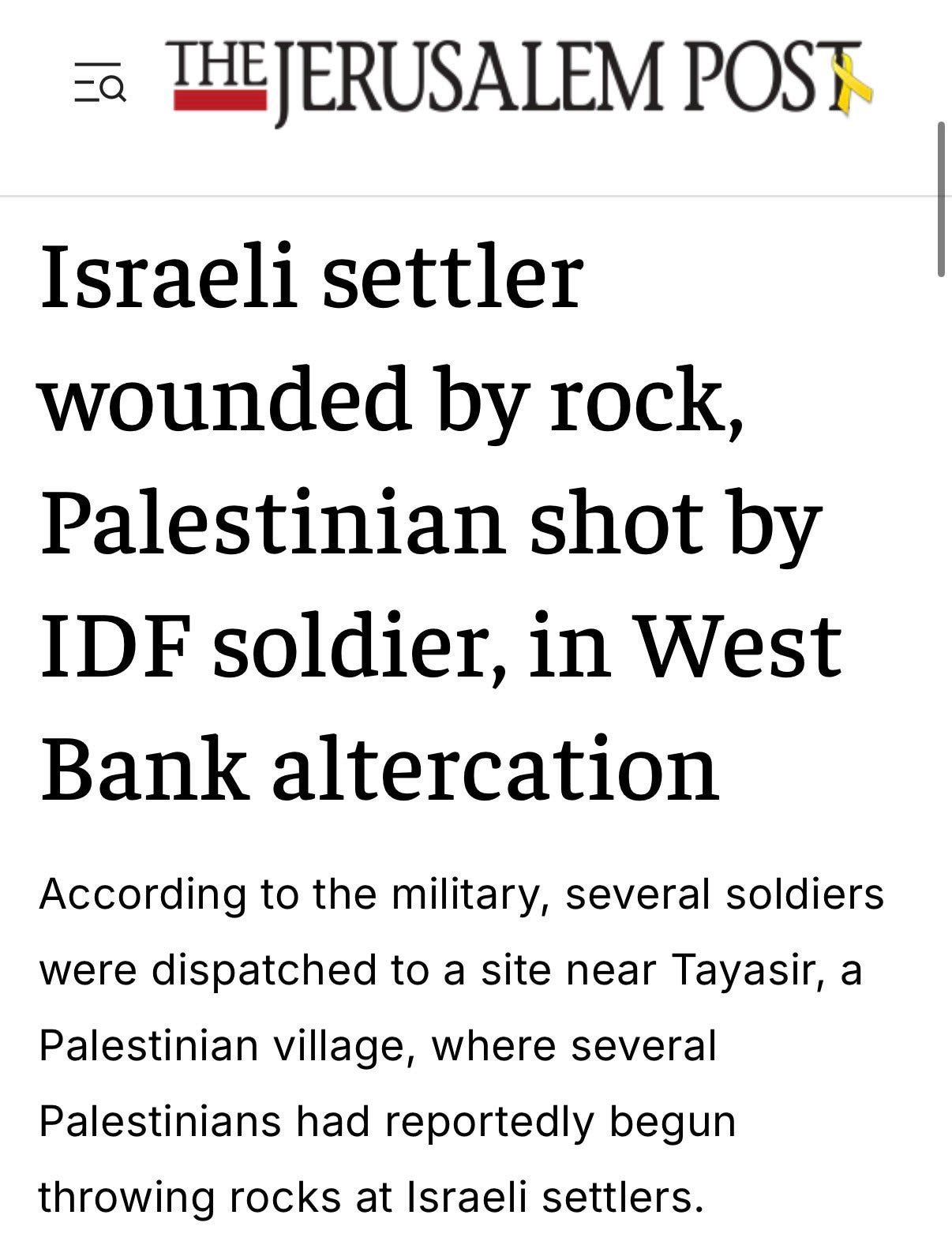
Centrist and right-wing media in Israel were quick to label the murder near Tayasir as a foiled terror attack—quite a way to describe a response to an armed invasion. But, again, this is precisely the point of these settler incursions or “land patrols”: to “generate friction.” To Israeli authorities, the Palestinian response to this “friction” is known as “terrorism,” which then serves as justification for additional state and military resources. IDF chief Eyal Zamir admitted as much during the meeting in which 34 new settlements were approved, reportedly telling the cabinet that “he was ‘raising 10 red flags’ over the IDF’s manpower levels, arguing that the military would need additional personnel to meet its expanding operational demands, including those stemming from settlement expansion.”
From my piece, Good Settler, Bad Settler, in November:
Just this week, the Knesset advanced a bill granting major new tax breaks to West Bank settlements deemed “under threat,” a designation made by the IDF Central Command, inseparable from the dynamics of encroachment that produce those threats: The deeper a settlement pushes into Palestinian land, the more “dangerous” its surroundings become, manufacturing the “insecurity” that then entitles it to further state support.
The irony here—and what Zamir may be hinting at—is that many people believe the devastating effectiveness of the October 7 attack was, in part, a consequence of the IDF being stretched thin protecting West Bank settlements rather than stationed along the Gaza border. And October 7, of course, led to the annihilation of Gaza, which has quietly transitioned into a process of resettling it. That is to say, October 7 has proven to be a boon for the settlement movement across the Land of Israel.
“But Jasper,” you might ask, suspiciously, “do you really think that all of this—the provocations, the violence, the condemnations—is meant to expand the settlement project?”
“At the end of the day,” I retort, narrowing my eyes, “all roads in Israel lead to settling.”
If you found this piece of journalism valuable, consider upgrading to a paid subscription so I can keep doing this work.
More specifically, Reingold decided to be Jewish on October 8, 2023, and it has certainly paid off for her career.

Feel free to delete this but I take so much issue with people who “became Jewish” after Oct 7th. It tells to me, they only see their identity with Judaism when they get to be thee victim and use their victimhood. It’s a shallow reading of Judaism and so irritating.
I laughed out loud reading the fun the internet had with your comments.