
The Most Predictable Place On Earth
A historic settler killing spree unfolds in the West Bank. Who could've seen it coming?
Note to readers: I’ve recently taken the plunge into full-time writing and reporting, leaving behind the work that’s paid my bills for the past fifteen years. It’s both exciting and unnerving—journalism isn’t exactly a gold mine these days, and every bit of my reporting is self-funded. I travel with no crew, no security team—just me. But, at the risk of sounding sentimental, I’ve never felt more certain of my purpose.
Infinite Jaz exists because I believe reporting on Israel-Palestine, and the systems of power that shape it, should not be filtered through the priorities of billionaires and politically biased, risk-averse institutions.
But it cannot continue without your support. If my work has mattered to you, please consider becoming a paid subscriber—you’ll gain access to the full archive of subscriber-only reporting and help cover my upcoming reporting trips to the West Bank.
Through the end of the month, I’m offering 20% off for an annual commitment—just over $5 per month:
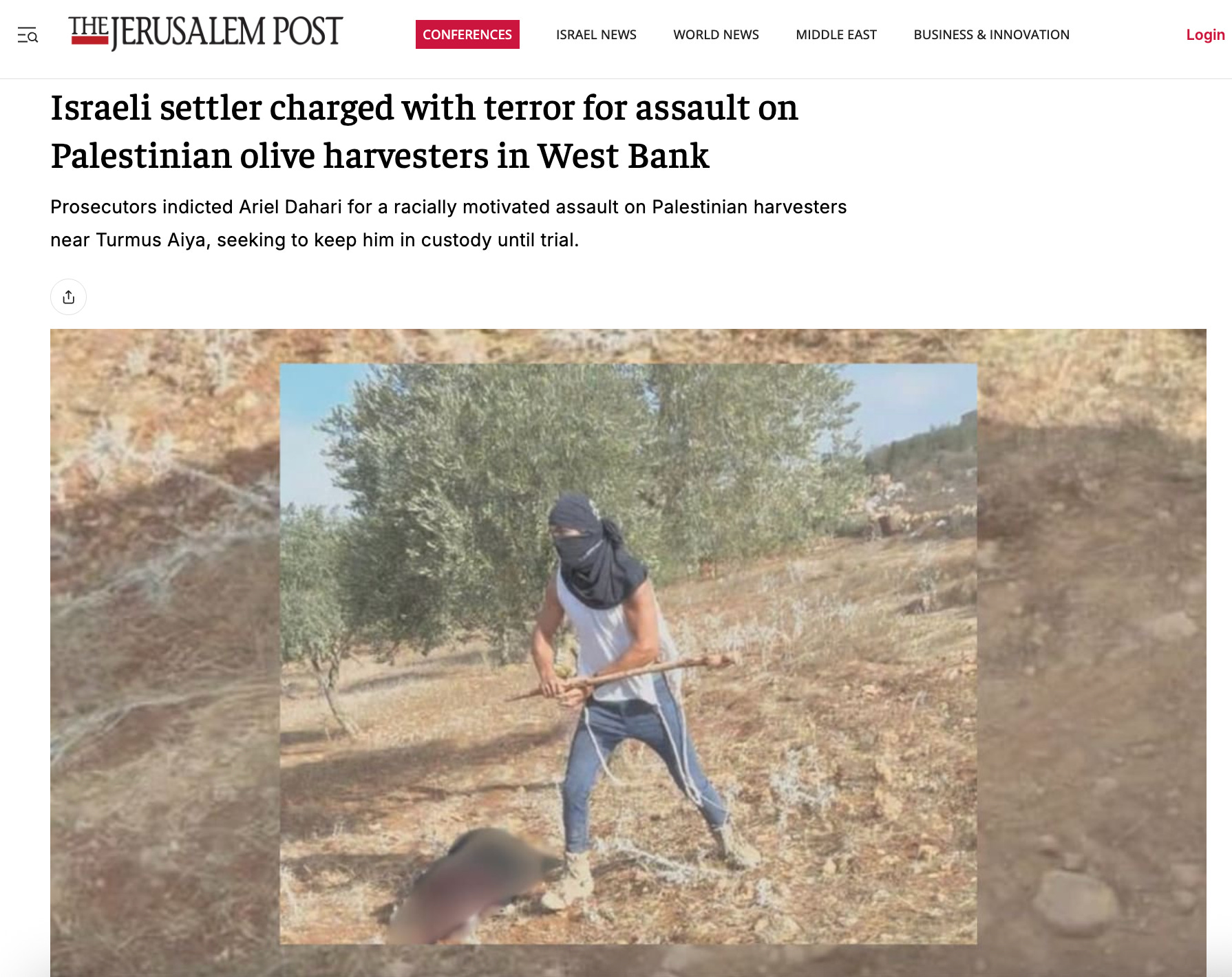
When I was ambushed by a mob of settlers in the Turmus’ayya olive fields last October, I predicted that Israeli authorities would respond with a token arrest designed to absorb international outrage over the viral footage, while leaving the terror network itself, led by the notorious settler Amishav Melet, intact.
That is exactly what happened. Three weeks after the attack, Israeli authorities arrested a single settler, Ariel Dahari, charging him in connection with the brutal clubbing of a Palestinian grandmother.
Meanwhile, Melet’s outpost—the operational hub of the regular attacks on Turmus’ayya—has only expanded. In footage from that day, you can see a large, beautiful house perched above the olive groves. Look on the left-hand side of the below video. (For new readers: that is me in the black shirt, running from a lynch mob of settlers.)
This past week, the daughter of the Palestinian-American who owns that house reached out to tell me that settlers had officially moved in. Here they are, making themselves at home:
To spell it out: Israeli authorities responded to a widely publicized act of settler violence by allowing the perpetrators’ base to expand. As part of that expansion, settlers have now stolen and occupied the home of an American citizen. The U.S. Embassy has declined to offer the family any assistance.
Frankly, it’s not hard to predict what will happen in the West Bank if you’re paying attention. In November, I wrote about a dangerous road cutting through Umm al-Khair, the Bedouin village where Awdah Hathaleen was shot dead by a settler months earlier:
The Carmel settlement sits at the top of a hill in South Hebron, with several roads leading to it. Lately, settlers favor the one that cuts directly through the tiny Palestinian village of Umm al-Khair—the scenic route, if you will. The road splits the homes from the community spaces, so children often play in the street. In the US, there would be speed bumps, stop signs, warnings that children are at play. Here, the Palestinians know if they put these up, the Israelis would tear them down. I watched a mother drive a minivan full of children at least 50 miles per hour through the village, honking at the Palestinian kids to scatter like they were sheep in the road.
Everyone in the village knew it was only a matter of time before a child was hit by a car here. On Friday, it happened:
The five-year-old girl was hospitalized, but is okay.
I don’t know whether the driver meant to hit her. Israeli authorities called it a traffic accident. What’s the difference? What is the point of denying a street busy with children a speed bump if not to make an “accident” inevitable?
The young Jewish American activist who documented the incident is in the process of being deported by Israel. Next time, they hope, no one will be there to document it.
Settlers have ensured that every aspect of life in Umm al-Khair is tenuous. Pairing this with routine, overt violence, they hope that families will eventually pick up and leave—something more than sixty communities have done since October 7.
For settlers, this is a form of recreation. Again, from my piece about Umm al-Khair:
Another time, two settlers on an ATV slowed down and called out, “How do you like your new neighbors?”
The “new neighbors” are the settlers, led by the infamously violent Shimon Attia, who broke off from Carmel in August to plant an outpost just meters from the village community center. The land isn’t any richer than up on the settlement. The view is no better. There’s no practical reason to move in—except to torment the Palestinians next door. In settler logic, this is as good as beachfront property.
Just look at this group of settlers and reservist soldiers that took a field trip to a Palestinian village north of Hebron for target practice:
They’re having fun! And had somebody been shot and killed, you can bet the settlers would have claimed self-defense.
As this video made the rounds on X, the settler activist Elisha Yered shared a response: “A video in which any reasonable viewer can discern that it involves a group of hikers who were guarding the skies, hiking in a place that, according to the antisemitic Arabs… Jews are forbidden from entering, and therefore they were attacked by Arabs.”
Just a group of hikers guarding the skies! It would almost be funny if they weren’t killing Palestinians at a historic rate.
Here is Yered again, describing an incident on March 7 in Susya, a tiny village in Masafer Yatta left exposed after the army declared it a “Closed Military Zone,” barring activists while allowing settlers free access:
“A serious terror attack took place this Shabbat against a Jewish shepherd in the Hebron Hills:
Initial details indicate that about ten armed Arab rioters wielding clubs attacked a Jewish shepherd in the grazing areas adjacent to the Susya settlement in the Hebron Hills at midday on Shabbat.
An IDF soldier who rushed to the scene carried out a suspect apprehension procedure toward the rioters and saved the shepherd’s life, according to Yesha Rescue Without Borders.
Later, the Arabs reported that one of the rioters was killed by the gunfire during the attack and his companion was seriously injured. The shepherd was miraculously only lightly injured and was evacuated to Soroka Hospital.
Police forces that arrived at the scene located evidence left behind by the fleeing rioters, including several of the clubs used in the attack.”
Now, here is what actually happened:
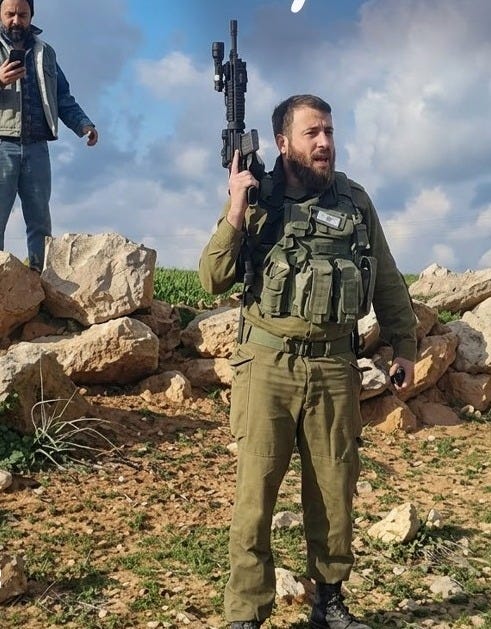
Settlers, some in army fatigues, brought their livestock onto Palestinian farmland in Susya and attempted to drive the animals into villagers’ homes. The residents—or “rioters,” in Yered’s telling—tried to push them back, and were beaten with clubs. One settler opened fire. Amir Shanaran, 28, was shot in the neck and killed. His brother Khaled was shot in the abdomen and survived. Several others were injured. A woman was run over by a settler on an ATV, breaking her leg.
Here is one of the settlers who “miraculously” survived:
Days later, settlers stormed the home of the man they killed and terrorized his grieving family.
On a podcast last week, Yered—who was once detained over the fatal shooting of a Palestinian teenager; is an open theorist of coordinated settler-state land seizures; was present during last month’s pogrom that killed a Palestinian American; and was recently feted at a Knesset tribute to the settlement movement—explained that settler violence in any form is fundamentally an act of self-defense.
“There’s an enemy here who is waiting for the day it can murder me, and I’m not willing to be Kfar Azza,” he said, invoking a kibbutz attacked on October 7. “I will do everything I can to expel it, to hurt it.”
“There’s obvious self-defense,” he continued, but also: “the best defense is offense.”
Yered’s claim reminded me of something I heard from a settler in 2024, who, in justifying the brutal IDF raids in the otherwise quiet village of Sebastia, compared them to the U.S. invading Iraq before Saddam Hussein had a chance to use WMDs against us, apparently unaware of how that turned out. (Thank God, at the very least, the U.S. has learned its lesson.)
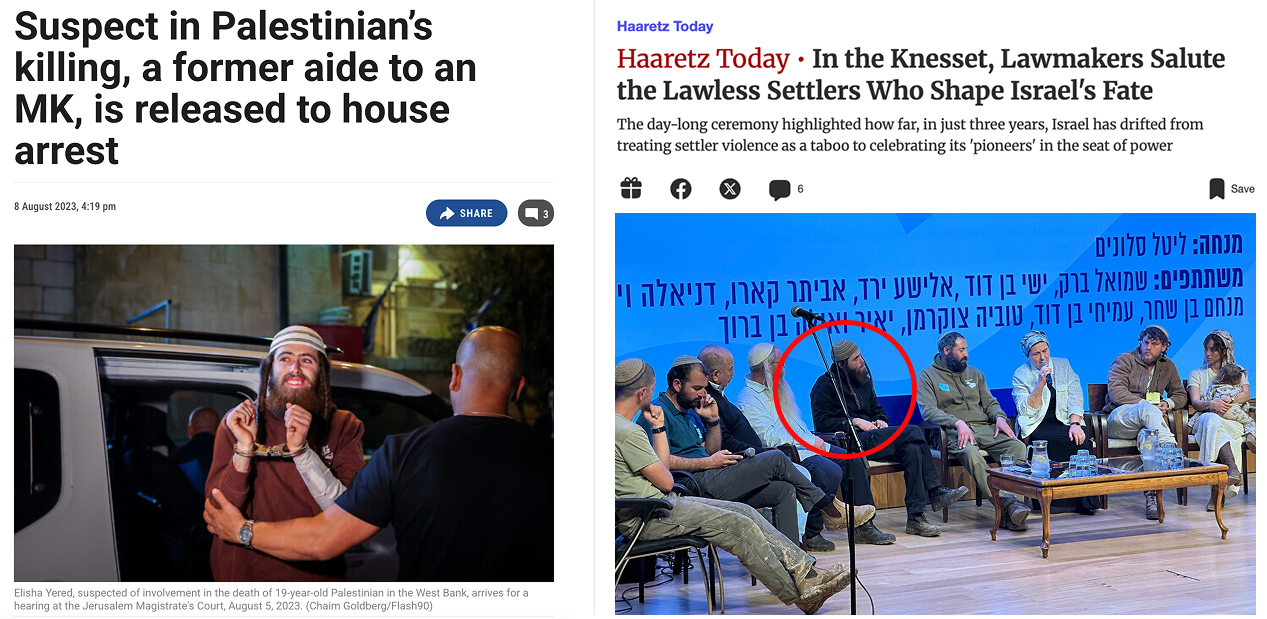
Yered goes further than the language of preemptive defense. Like most settlers—and much of the Israeli government—he believes Jews have an inherent right to the entirety of the West Bank, or “Judea and Samaria.” Settler incursions into Palestinian communities, he says, are designed to provoke violence that can then be met with overwhelming state force and eventual depopulation.
“Without question, we are initiating friction,” he said. “And we’re proud of that.”
He also dismissed Netanyahu’s characterization of settler violence as the work of a marginal fringe—“about 70 kids,” as the prime minister once put it. “It’s really not 70 or 700,” Yered said. “It’s much more.” When arrests do occur, he noted, they often involve the sons of prominent rabbis and members of established settler families.
In the first week of the Israel-U.S. war on Iran, settlers and soldiers killed at least six Palestinians across the West Bank and injured more than fifteen. In addition to the March 7 killing, settlers shot and killed two brothers on March 2 after invading their land in Qaryut. On March 8, masked settlers stormed the village of Abu Falah around 2 a.m., wielding clubs and setting olive trees on fire. When residents came out to defend their homes, dozens more settlers arrived. Two men—Thaer Farouq Hamayel, 24, and Farea Jawdat Hamayel, 57—were shot in the head and killed. When Israeli soldiers arrived, they fired tear gas into the village. Another man, Muhammad Hassan Murra, 55, went into cardiac arrest after inhaling it and died.
Elsewhere, in the northern Jordan Valley, dozens of settlers carried out a prolonged night raid on the hamlet of Khirbet Humsa, one of the last remaining communities in the area. Masked attackers handcuffed family members—including children—and foreign activists, dragging them into a tent. The children were forced to watch as adults were beaten, doused with water, and humiliated. Witnesses described a sexual assault on one Palestinian man, as well as theft and the release of livestock from their pens. Several victims required hospitalization. One international activist later said she believed they were about to be raped or burned alive. A resident recalled the attackers warning: “Today we will take your sheep, but the next time we come here we will burn the houses, kill the children and rape the women.”
Many observers have suggested that the latest wave of settler attacks is unfolding “under the cover of the war with Iran.” There may be some truth to this, but settlers were already operating with unprecedented confidence before the first bombs fell on Tehran. The machinery of violent displacement had been accelerating for months. Now it is simply running more smoothly and with less need for disguise.
Maj. Gen. Avi Bluth, who oversees the IDF in the West Bank, called the spike in violence “unacceptable,” adding that there would be “zero tolerance for civilians who take the law into their own hands.”
Put aside, for a moment, that Bluth presides over a command structure that has systematized the establishment of outposts from which many of these attacks originate—overseeing a formalized pipeline in which illegal “farms” are planned, approved, and secured in coordination with regional military units, complete with allocated forces and logistical support. What is particularly useful about his comment is the tacit acknowledgment that terrorizing, displacing, and killing Palestinians is, in fact, the law—and the job of the Israeli military.
Last week, a tiny Bedouin community east of Duma was violently emptied by settlers with an assist from the IDF. For months, settlers had waged daily and nightly pogroms against the encampment, and the residents had come to depend on the presence of activists to survive.
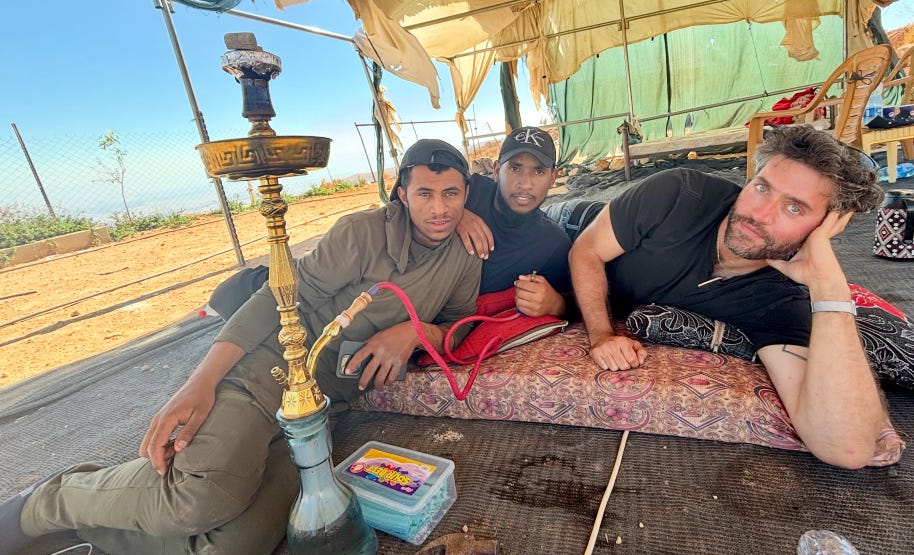
I spent time there in October, staying up late into the night with two young men, Raed and Mohammed. By then, all the women and children had already fled, and a small group of men remained to maintain a fragile foothold on the land.
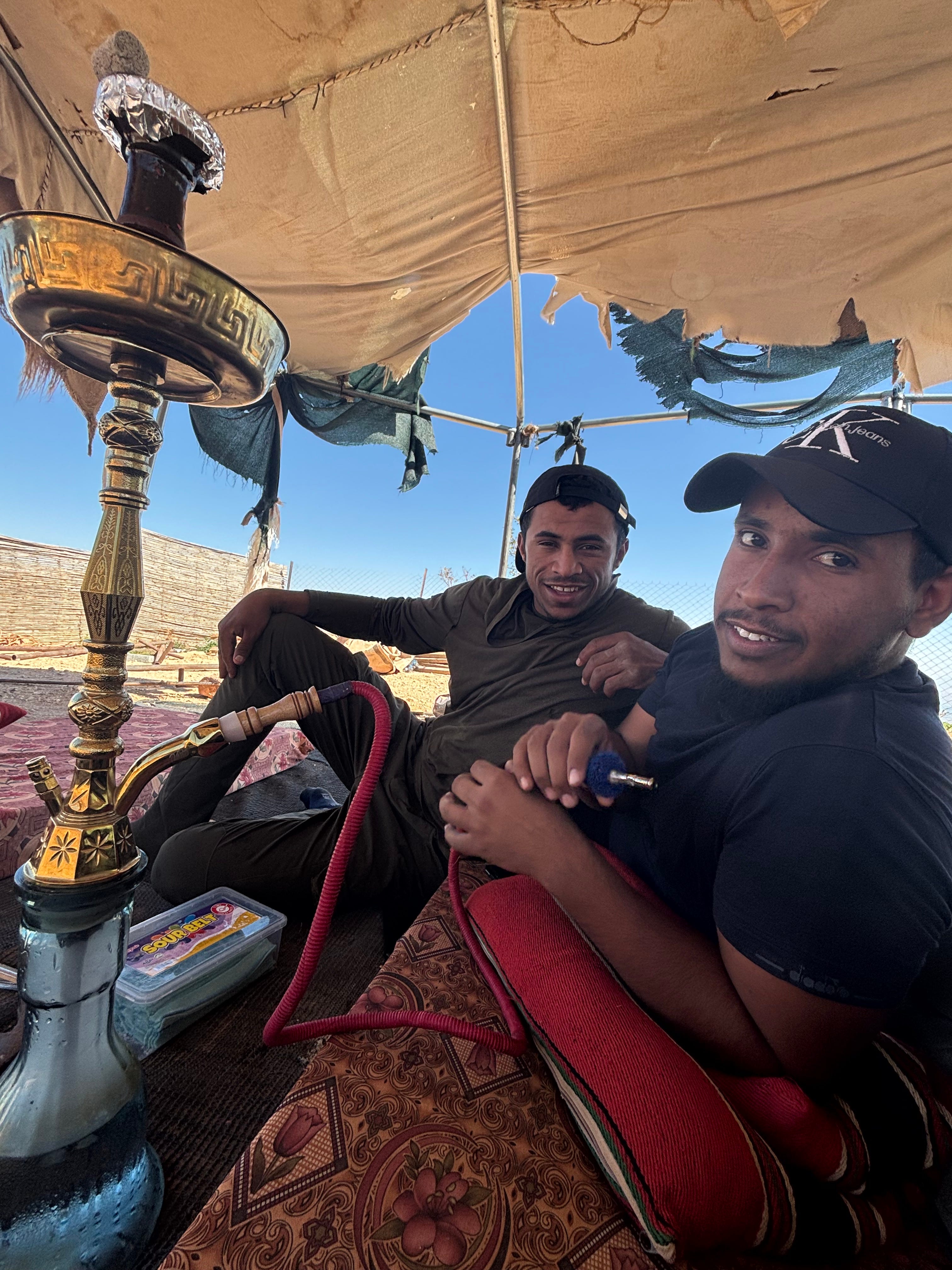
This video is one of my favorites from my time in the West Bank—not because I beat Mohammed in an arm wrestle (handily, tbh), but because it reminds me that even amid the constant horrors Palestinians here face, there are still moments when guys can just Hang Out. More than anything, it’s the laughter in the video that gets me. This scene could’ve unfolded at a bar in Brooklyn.
Settlers drove along the outskirts of the encampment after dark, revving their engines and shining floodlights into our exposed sleeping quarters. In the morning, they crossed the gate they had already smashed and filmed us in the camp itself. The community is pinned against a steep valley by a growing outpost; in the event of a full-scale attack, there is nowhere to run. Last year, as the outpost was being built, a settler shot and killed a local Palestinian here.
In the months since my visit, the harassment intensified: electricity lines cut, homes vandalized and filled with pepper spray, and residents repeatedly forced to flee. Eventually, the IDF declared the village a “Closed Military Zone,” barring activists from entering—a familiar tactic that creates the appearance of restoring order while leaving Palestinians more exposed to settler violence. The assaults intensified immediately, and the remaining residents understood that if they stayed, they might be killed.
Now, the Palestinians are gone, and the settlers are sure to move in soon. Who could’ve seen it coming?
The Israeli government’s response to this mounting violence has made its priorities increasingly clear. After a late-February video went viral showing an activist being brutally assaulted while begging for her life— shouting “Help!” “No!” “Please, no!”—authorities quickly announced three arrests. A week and a half later, the charges against the masked terrorists in the video below were quietly dropped.1
The ATV the settlers climbed out of is a Polaris Ranger—one of many such $20K+ vehicles gifted to outposts by the Israeli state.
In Jerusalem, meanwhile, National Security Minister Itamar Ben-Gvir dramatically expanded eligibility for civilian firearms licenses, extending blanket access to hundreds of thousands of additional Jewish residents.
It’s important to understand that there are no meaningful obstacles standing in the way of the spiraling violence in the West Bank. On the contrary, settlers are being rewarded for these attacks with guns, ATVs, funding, and state authorization that converts their violent gains into formally recognized Israeli land, while the cabinet continues to expand the legal routes through which such dispossession can proceed.
I predict that things will only get worse.
A few stray thoughts before I sign off.
Thirty-one senators signed onto Chris Van Hollen’s letter demanding a U.S. investigation into the killing of Philadelphia native Nasrallah Abu Siyam by settlers in the West Bank. Among those who inexplicably declined to sign were both Pennsylvania senators—John Fetterman and Dave McCormick—as well as New York’s Chuck Schumer and Kirsten Gillibrand. In my eyes, this is as good as a cover-up; I really cannot fathom the moral depravity that could explain their refusal to demand even the most basic accountability for the killing of an American citizen.
Fred Guttenberg, whose daughter was killed in the Parkland school shooting and who later became an activist, said on X that Gavin Newsom “crossed the line” by referring to Israel as an apartheid state. I found this to be a striking display of selective empathy, given that I know dozens of parents in the West Bank who are grieving just like him but will never see their child’s killer brought to justice, as he did, because of Israel’s two-tiered justice system—one of the clearest examples of Israeli apartheid.
This photo of Mikaeil Mirdoraghi, a third-grade student killed in the U.S. double-tap strike on a primary school in Minab, Iran, has haunted me. There are millions or even billions of people in this world who, like Fred Guttenberg, fundamentally do not understand that children everywhere are the same. This precious child, the tens of thousands dead in Gaza—people don’t connect them to the idea of their own child being violently killed. If they did, I do not think Israel's and the U.S.’s relentless atrocities would be tolerated.
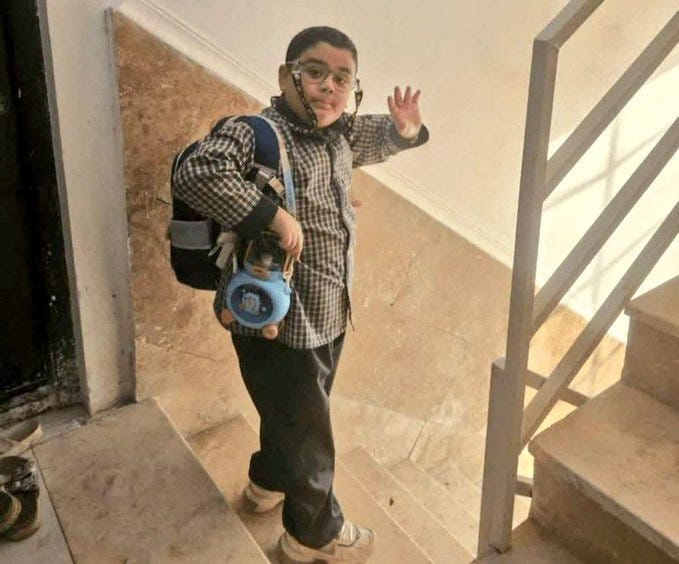
A useful thought experiment is to imagine what would happen if a foreign military bombed a school in the United States—say, one near you—and killed more than 150 people, most of them children. My feeling is that the responsible country might not exist for much longer.
In Lebanon, over 100 children have been killed by the Israeli military in the past week. Has this even registered for the people who support Israel’s ever-expanding wars? Do they even know? The deaths are completely negligible.
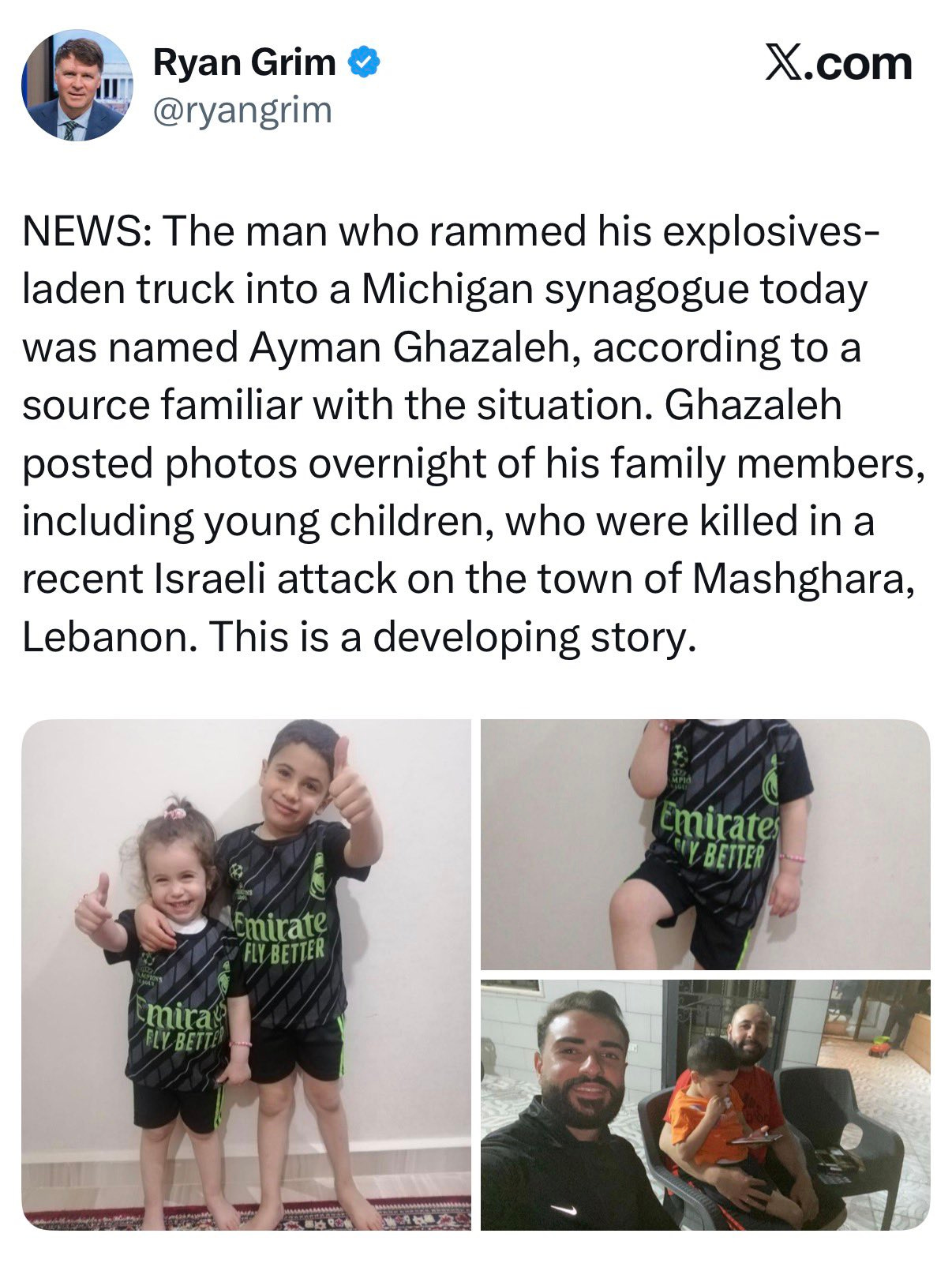
To some, they are not. On Thursday, an armed man rammed a truck into a synagogue in Michigan. Reports quickly surfaced that he had lost relatives, including children, in a recent Israeli strike on Lebanon:
Here is ADL chief Jonathan Greenblatt after the attack, lamenting that Jewish people and the Jewish State—interchangeable to him, as made clear in this clip—are being blamed for the “war in the Middle East”:
Has anybody done more than Greenblatt to ensure that the actions of Israel are experienced as inseparable from Jewish identity?
Days before, he characterized protests against the war on Iran as a form of hate that traffics in antisemitism. Here is the photo the group used to illustrate the point:
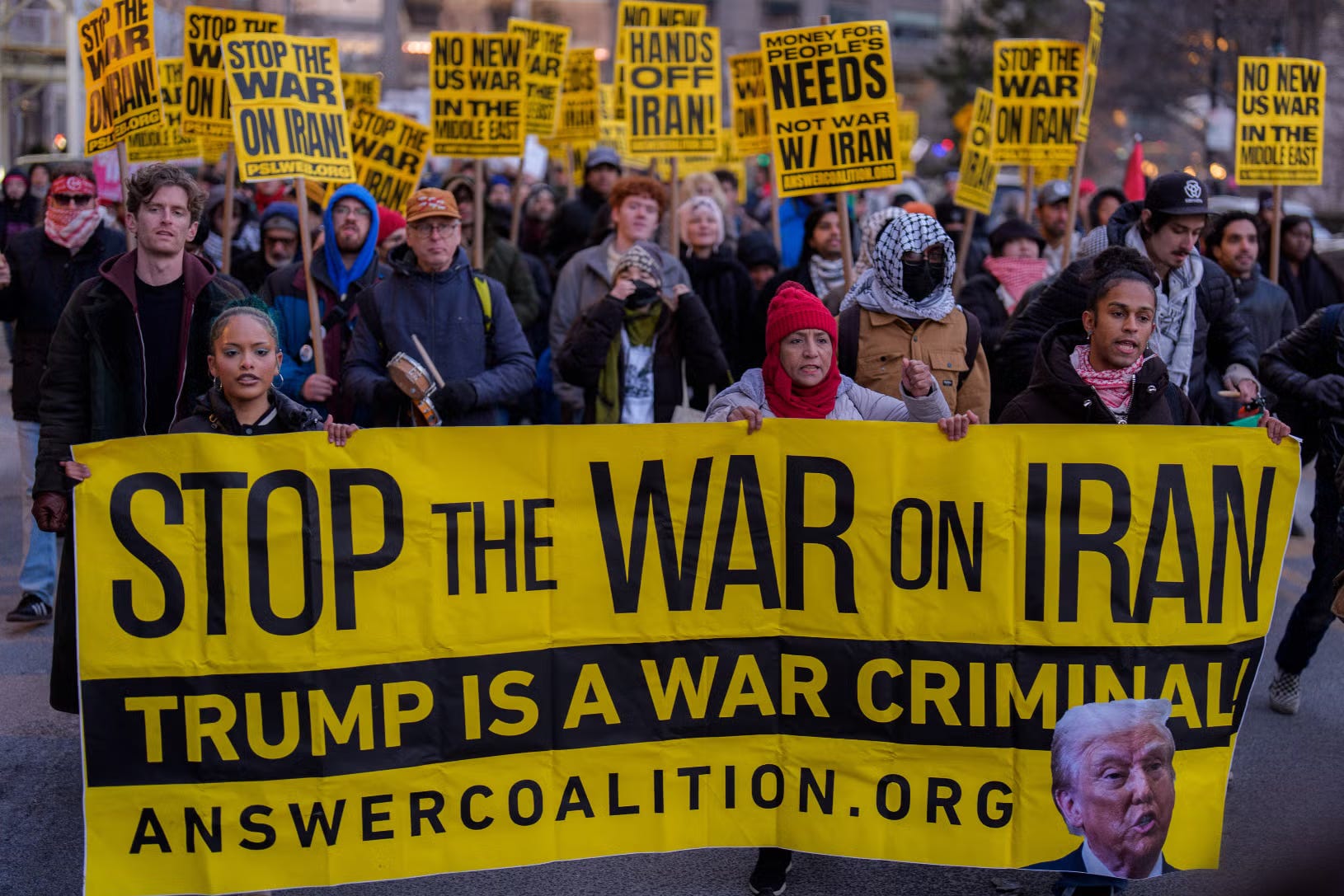
The blowback of Israel’s relentless aggression has officially arrived. Greenblatt—and every Jewish institution that has refused to show any daylight with Israel—has put all of us at risk.
On the subject of blowback, here is one final passage from my piece about Umm al-Khair:
“The soundscape of Umm al-Khair is otherwise ordinary for a farming community—sheep, roosters, children at play—but here, there is also Hebrew chanting. For three days, I heard it constantly. The children of Umm al-Khair peeked over the fence, where just meters away, men in kippahs with machine guns slung over their shoulders danced and sang. I recognized many of the songs and prayers from my own childhood going to synagogue. Hearing them in this context was disturbing in a way I cannot put into words. What it must do to a child’s understanding of Jews doesn’t need spelling out.”
And a video from Qusra this week (make sure to watch with the sound on):
Again, settlers arrived in a state-gifted Polaris Ranger ATV. One day later—yesterday—they returned to Qusra, shot a man dead, and stabbed his father.
If this child grows up seeking revenge, you can be sure of one thing: he’ll be labeled a terrorist.
Postscript:
As I was preparing to send this out, reports emerged that four members of a single family had been shot dead by Israeli forces in Tamoun—Mohammed, 5; Othman, 7, who was blind and had special needs; and their parents, Waad, 35, and Ali, 37—all reportedly struck in the head and face as they drove home from a Ramadan shopping trip. Two children survived. One later said that soldiers pulled him from the vehicle and beat him, shouting, “We killed dogs.”
Israeli authorities said without evidence that troops opened fire after “perceiving an immediate threat” when the vehicle accelerated. There is no reason to believe this is true.
Elisha Yered, the government-supported settler activist again, wasted no time in responding to the incident on X:
“This is about a terrorist family that was nearly completely eliminated.
A father, mother, and two children aged 5 and 7.
I'm glad to see that the IDF backs its fighters who eliminated those who needed to be eliminated when they felt in danger, without regard to the identity of the eliminated - apparent non-combatants or whoever they may be.”
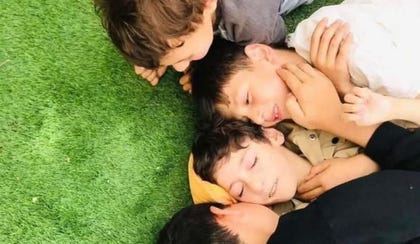
Here are the two surviving children:
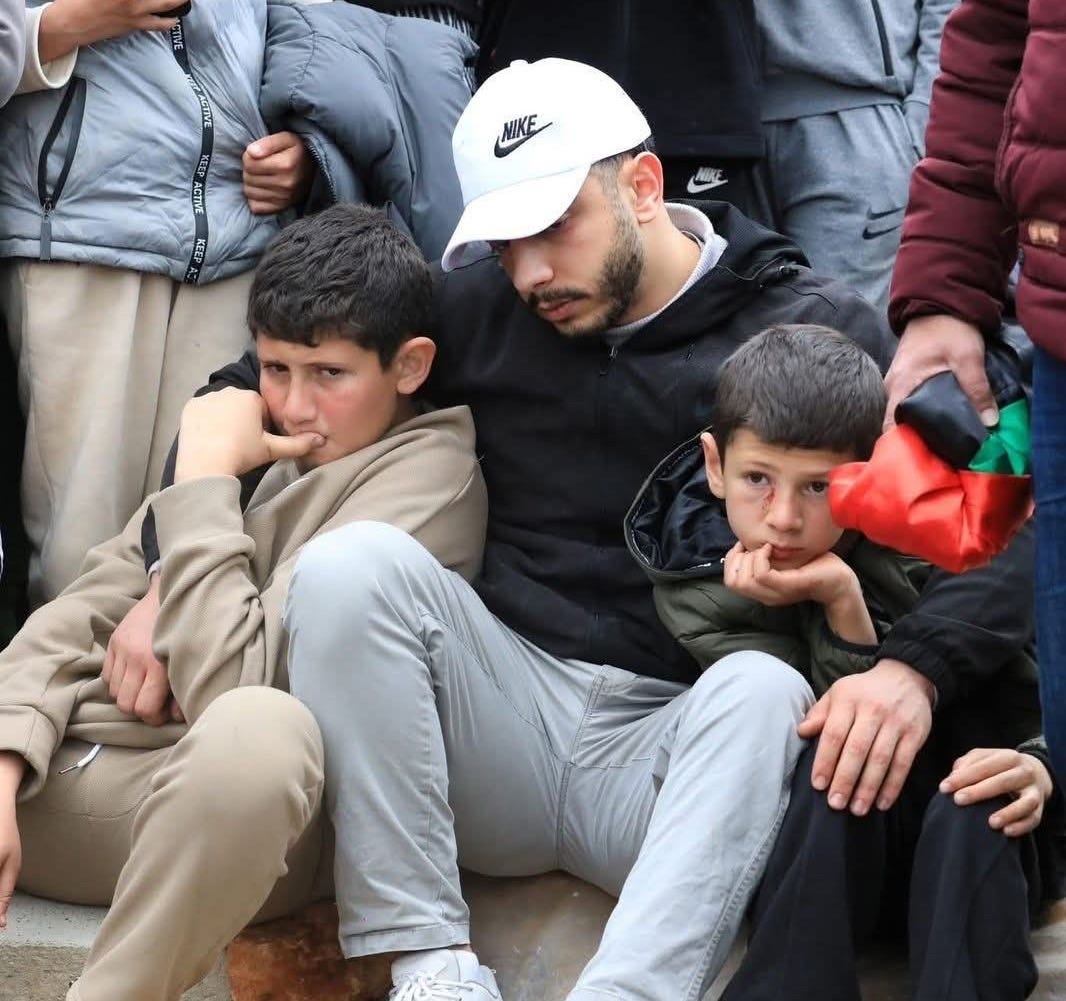
The most pressing question, in my mind: What sort of a life awaits them?
Also on Thursday, Israel’s top military lawyer dropped charges against five soldiers filmed sodomizing a Palestinian detainee who was later released with severe internal injuries and no criminal charges. Prime Minister Benjamin Netanyahu dismissed the allegations, backed by video evidence, as a “blood libel” and called the men “heroic fighters.”
This is true journalism! Continuing to support your work
Subscribed. Thank you, keep up the great work.🙏🙏🙏